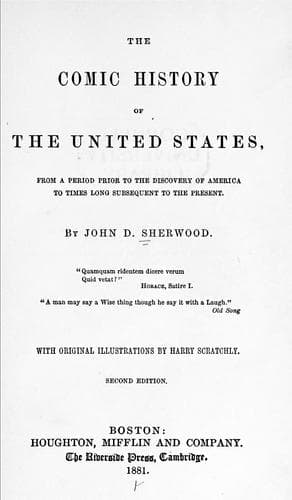
The comic history of the United States, from a period prior to the discovery of America to times long subsequent to the presentSherwood, John D.
History
The comic history of the United States, from a period prior to the discovery of America to times long subsequent to the present
Sherwood, John D.
United States -- History -- Humor
Worsted in square fighting, squadron to squadron, and vessel to vessel,
the enemy—not having the fear of this History before their eyes, and
finding it easier to harass unarmed merchantmen and to pillage
unprotected coasts—ravaged the Chesapeake, burned the Capitol at
Washington,—whose corner-stone had been laid by the great American
himself in 1793,—and laid in ashes the President’s house. Unfortunately,
the Washington Monument was not yet begun; and thus by its escape made
the destruction as unpardonable by taste as it was by the code of
nations. Baltimore pluck defended Baltimore beauty from attacks by land
and water; but the dry goods and shipping of Alexandria were bravely
captured and taken prisoners. Weary of the marine parades before New
York, Newport, and Stonington, at the North, and Mobile, at the South, a
descent upon the city of New Orleans was finally planned by the British
military commander, with fifteen thousand hardy and well-seasoned
veterans, led by Sir E. Pakenham. To two thousand of them it was a
sudden descent to Avernus. Their shades, on every recurring 8th of
January, have since been vexed by the sad rites of oratory, poured out
on every American stump and platform. Cotton for the first time was here
invested with belligerent rights, from its use by General Jackson and
his six thousand troops as breastworks. It has ever since been roundly
employed by American ladies in the same way against their ardent
admirers. The result in the latter case, however, has usually been, not
to repel but to heighten the vivacity of the attack; and, unlike that at
New Orleans, to procure the surrender of the party with the
cotton-works.
The battle of New Orleans was fought in ignorance of the treaty of peace
between the United States and Great Britain, signed twenty-five days
previously, December 14, 1814, at Ghent,—an agreement which, like
frequent make-ups of other quarrels, was wholly silent upon the
questions which had caused the long and harassing contention.
On these questions the United States were left at sea.
The war had cost thirty thousand lives and over $100,000,000; but we
gained flags, fame, self-confidence, a fine crop of candidates, and
subjects for speeches. Through the annealing flames we came out blue
steel.
During the December descent on New Orleans, delegates from five of the
New England States took Hartford and used it to pass some resolutions
against the mode in which, as they asserted, those States had been left
out in the cold, bare and unprotected by the government. Many
conventions have been since held at the same place and gathered up
denunciations with characteristic American fervor; but this one has got
somehow astride of history, and ridden it without bridle or stirrups.
Public-domain text, read in full here on John Shaqi.
Reviews
Reviews
No reviews yet
Be the first to share your thoughts on this work.
Elsewhere in the archive
Join the Discussion
Join the discussion
Sign in to leave a comment or review.
Sign InorCreate an account