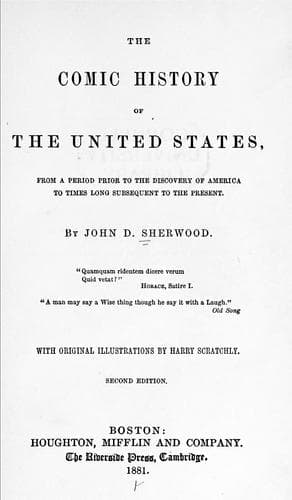
The comic history of the United States, from a period prior to the discovery of America to times long subsequent to the presentSherwood, John D.
History
The comic history of the United States, from a period prior to the discovery of America to times long subsequent to the present
Sherwood, John D.
United States -- History -- Humor
Reference, by Believers in the Transmigration of Souls, to Mr. Pierce
for its Proof.—His real and apparent Age.—The Slave Colossal Figure
bestrides the Presidential Harbor.—How the New President rode in
between its Legs, and cast out a curious Anchor.—An Antediluvian
Cabinet.—Still Times expected.—Sudden Freshet.—Douglas breaks the
Missouri Dike.—Bitter Waters over the Land.—Alarm among the Elderly
Gentlemen, and how quieted by J. Davis.—Alarm North and South not
quieted.—The African Outlook towards the North Pole.—The Power of
Douglas illustrated from his Scotch Namesake and Proverb.—What
Warriors rushed to our Flanders.—The Blow on the Head of Sumner and
Slavery from Brooks’s Cane.—The Dred Scott Essays.—American
Africanization.—An Exploring Party in the Interior.—Discovery of an
Extinct Race, and of Fremont.—Undiked Waters not strong enough to
float Douglas into a Nomination.—Buchanan in the Dock.—The
Know-Nothings make a neat little Present to a Polite Gentleman.
Believers in the doctrine of transmigration of souls point to Franklin
Pierce for its triumphant demonstration. Although by ordinary reckoning
but forty-nine years old when, in March, 1853, he came out of New
Hampshire to be President of the United States, he must have lived—so
they assert—somewhere through several previous existences and brought
along with him the last time the cherished notions of the first.
Certainly he was as much of an anachronism as a two-handled plough,
dragged by a yoke of oxen, contrasted with a steam one driving its hot
shares through dissolving acres, an undecked Roman trireme rowed against
an iron-breasted monitor armed with the heaviest modern gun, or an
old-fashioned scythe in comparison with a mower.
His ideas of government were scant for a good-sized town, and of slavery
so patriarchal, that a Red River planter might have taken several
lessons from him with great profit.
Slavery at that time, like the colossal statue of Apollo at Rhodes,
stood with its two feet widely apart. Its right was planted in the
commercial cities of the North, covered with a huge stocking of Northern
manufacture; its left, spread out like Sambo’s, all over the Gulf
States, was carefully enwrapped with raw cotton. Between its wide-spread
legs Mr. Pierce, like an ancient mariner, sailed into the harbor, and
cast out an anchor, forged at Baltimore, or it may be at Nineveh, with
an inscription on its best fluke, “No agitation about slavery.” It might
as well have been inscribed, “No more thinking.”
He asked several elderly gentlemen to help him have a good quiet time:
William L. Marcy, with the portfolio of State; James Guthrie, incubating
the snug little Treasury nest; Jefferson Davis, with the appropriate
red-lettered War rifle; Caleb Cushing, holding the Attorney-General’s
fool’s-cap brief; Robert McClelland, bringing an oaken inlaid table for
the Interior; and James Campbell, an old-fashioned letter-weigher.
Public-domain text, read in full here on John Shaqi.
Reviews
Reviews
No reviews yet
Be the first to share your thoughts on this work.
Elsewhere in the archive
Join the Discussion
Join the discussion
Sign in to leave a comment or review.
Sign InorCreate an account