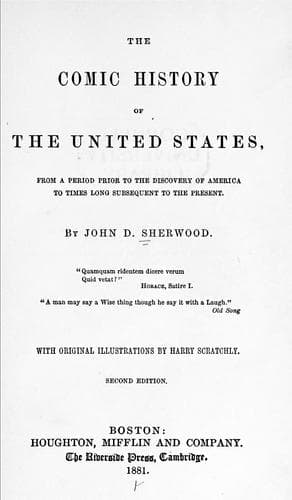
The comic history of the United States, from a period prior to the discovery of America to times long subsequent to the presentSherwood, John D.
History
The comic history of the United States, from a period prior to the discovery of America to times long subsequent to the present
Sherwood, John D.
United States -- History -- Humor
They expected to have a good antediluvian time of it, as Mr. Clay’s
compromise carry-all had transported into the wilderness the bad-looking
lot which had broken into the peace of the gentlemanly Fillmore. Mr.
Buchanan was sent away to England, and some restless engineers somewhere
toward the Pacific,—a pleasant-sounding place far away out West,—to get
up a report on a railroad which might amuse the young people to read in
the long winter evenings.
Suddenly, however, all of these serene prospects were clouded. The great
shield, constructed by the Democratic Convention to hang in front of the
venerable President, and to prevent agitation, was found, in spite of
its solid-looking face, to be pierced on the inside by impertinent
little teredos, whose ceaseless boring had already begun to weaken its
resisting power. Other mariners wished to sail in between the
cotton-covered feet. And in January, 1854, one of these Presidential
seamen, from Illinois, named Stephen A. Douglas, leaped ashore on a
bluff point just outside the harbor, exclaiming with great lung power
that “every Territory had a right to do as it chose about slavery.” This
declaration from a Democratic friend startled the elderly party not a
little; but when that friend rose to a higher pitch and shouted that the
Missouri Compromise line of 1821 which kept slavery from all territory
north of 36° 30´, was unconstitutional, and leaping upon the solid old
dike, with bill and blow, crashed through it, letting out the bitter
waters of strife to flood with its pent-up strength all the wide land,
the antediluvian party started to their feet in great alarm. When,
however, Mr. Davis whispered to the President that this was only undoing
a modern wrong, and restoring ancient rights, that venerable gentleman
folded his arms and sat down contented.
Looking out upon the freshet, the bewildered Africans seemed to feel
that their only refuge was the north pole, now that even the wilds of
Kansas and Nebraska furnished only markets for their higher-priced
bodies. For a time the “little Douglas” appeared to look as large as the
colossus itself. He seemed to be as powerful in American politics as the
family of his Scottish namesake, which after intermarrying eleven times
with the royal stocks of England and Scotland, became so resistless as
to start the proverb, “No man may touch a Douglas, nor a Douglas man,
for if he do he is sure to come by the waur” (worse).
Public-domain text, read in full here on John Shaqi.
Reviews
Reviews
No reviews yet
Be the first to share your thoughts on this work.
Elsewhere in the archive
Join the Discussion
Join the discussion
Sign in to leave a comment or review.
Sign InorCreate an account