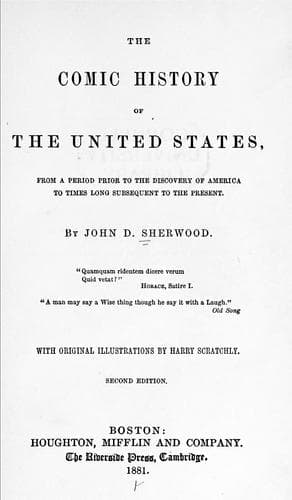
The comic history of the United States, from a period prior to the discovery of America to times long subsequent to the presentSherwood, John D.
History
The comic history of the United States, from a period prior to the discovery of America to times long subsequent to the present
Sherwood, John D.
United States -- History -- Humor
But the broad-wasting flood, poured out from the cleft dike, soon sent
an alarm throughout the North, and inspired terror among even the
conscientious of the South. To protect slavery—however repugnant—where
it existed in the old States was felt very universally in the North to
be a duty imposed by law, equity, and good neighborhood; but to batter
down a barrier which had been erected by both North and South, every
timber in which had been paid for by a price given and accepted, shook
nearly all consciences into sad action. Wherever the waters swept there
were land-slides from Democratic grounds. The shield against agitation
now crumbled like the stricken dike.
Kansas became another Flanders, where pikes, knives, and pistols were
carried at the plough, into private houses, through villages, and into
conventions. They were ever-present adjectives to the noun “man.” As in
the tropics, whirlwinds rush in towards the sun’s hot path, so towards
Kansas from Missouri swept advocates of slavery with bullets for the
settler and brands for his dwelling; from New England long-haired men
and short-haired women, ready all, some anxious, to be offered up for
the cause of freedom; from the Middle and Western States sharp,
bayonet-faced, earnest crusaders to rescue the threatened sacred ground
and to throw down the bronze statues and statutes. On the path of these
hot streams backward soon lay the scorched and burnt relics of slavery
in Kansas.
To slavery in the United States a moral blow was dealt by the cane of
Preston S. Brooks, aimed May 22, 1856, at the undefended head of Senator
Sumner, which had a few days before opened to express in emphatic words
its owner’s ideas about African barbarism in America. This appropriate
practical illustration of the argument was visible everywhere, and
became more potent than any books from or in behalf of the running
Brooks.
The cane given to the chivalrous Carolinian was a poor straw which did
not show the way the winds blew.
Still another blow was given by the Dred Scott opinion of a majority of
the Supreme Court, which advised the people in choice legal terms that
the dike was rightfully cut; that men with dark skins had no rights
which those with light ones need pay any attention to; and that
uncolored owners might take ebony bipeds along with their quadrupeds
into any State in any part of the Union without getting them out of an
unpaid state.
This Africanization brought out a new party,—called the Republican,—for
keeping the Territories free. Several political missionaries,
benevolently inclined towards our continent, started on trips into the
interior of America, bent, like Dr. Livingstone, on exploring regions
almost surrendered, like Africa, to the descendants of Ham. The result
was the discovery of a race, deemed almost extinct, who actually
believed that colored men might live unowned, and that Territories,
where slavery did not exist, would get along better without than with
it.
Public-domain text, read in full here on John Shaqi.
Reviews
Reviews
No reviews yet
Be the first to share your thoughts on this work.
Elsewhere in the archive
Join the Discussion
Join the discussion
Sign in to leave a comment or review.
Sign InorCreate an account