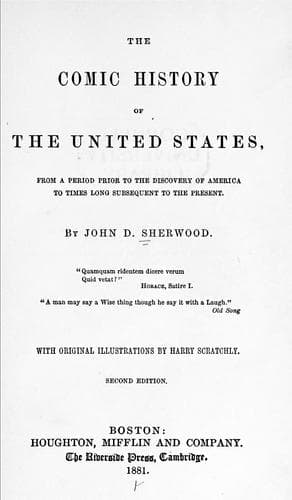
The comic history of the United States, from a period prior to the discovery of America to times long subsequent to the presentSherwood, John D.
History
The comic history of the United States, from a period prior to the discovery of America to times long subsequent to the present
Sherwood, John D.
United States -- History -- Humor
Suddenly, in the autumn of 1859, through the lurid light was thrust a
gaunt, resolute, earnest-looking form, with a face calm with long
excitement, over whose lines ran the savage history of Kansas murders
and house-burnings, fatal shots from border rifles at well-loved sons,
midnight escapes from Lecompton riders, and years of hunted violence and
wrong. From the close-shut jaws,—seldom opened now except for food, for
brief prayer before some new raid, or for an imprecation wrenched out by
some cruel recollection,—come no sounds. Across the bridge at Harper’s
Ferry, through the scared streets of that little garrisoned place, and
next into the jail it stalks. Then it flits into court, calmer than the
personated Justice, and then, marched between files of soldiers, to
fence off a phantom invasion, it mounts the scaffold. An old man, with a
grim smile stranded on the iron rim of his lips, swings in Virginia air,
and—John Brown’s soul goes marching on.
On the Southern heart this Quixotic invasion by a mistaken, personally
injured father, maddened by the losses of his sons, and unjustifiably
wreaking his individual injuries on a community innocent of any wrong to
him, laid a live, inflaming coal.
In April, 1860, the Democratic Convention met at Charleston. Some
gentlemen asked that body to declare its belief that the Union, having
been got up principally to hold Africans in an unpaid condition, any
uncolored owner could, by virtue of the laws of his own State, take
these bronze-colored bipeds,—always diffusing a bad odor unless to their
proprietors,—to any Territory. Not holding such a notion, the Convention
declined to make the declaration, but, on the contrary, asserted that
each Territory was competent to deal with the matter as it saw fit. The
question, thus resolved, was not of course to the minority
satisfactorily solved.
Following a convenient practice, deemed by some persons, unschooled in
such things, a little uncommon among gentlemen, of getting, if possible,
a decision favorable to their views which shall bind the minority, and
if unsuccessful repudiating the adverse decision as affecting them, the
delegates of six bronze-statued States left the unreasonable party,
carrying a banner with a dimly seen inscription, “Heads I win, tails you
lose, or, tails I win, heads you lose.” The convention, thus treated to
Breckinridge principles, adjourned to meet in June at Baltimore.
Meanwhile, in May, the missionary party, reinforced by numerous
converts, assembled and chose the Anak of Illinois as their leader. In
June the widowed Democratic Convention reassembled; but only to split up
into two family divisions, the one nominating the dike-breaker, the
other John C. Breckenridge, then Vice-President, and destined in a few
years to take, not the Presidency, but the very first prize for a
character which total depravity is occasionally permitted to offer, lest
fiction may invent a combination that shall outstrip reality.
Public-domain text, read in full here on John Shaqi.
Reviews
Reviews
No reviews yet
Be the first to share your thoughts on this work.
Elsewhere in the archive
Join the Discussion
Join the discussion
Sign in to leave a comment or review.
Sign InorCreate an account