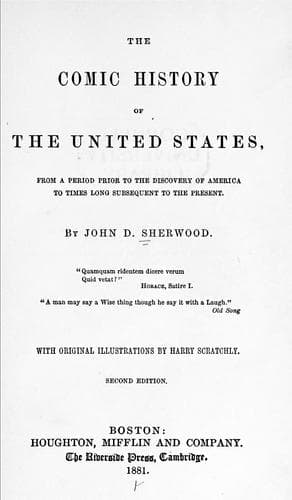
The comic history of the United States, from a period prior to the discovery of America to times long subsequent to the presentSherwood, John D.
History
The comic history of the United States, from a period prior to the discovery of America to times long subsequent to the present
Sherwood, John D.
United States -- History -- Humor
Of course the Drummond lights now burned brighter. Tar and oratory
illumined corner groceries and open-air meetings. Small men, set to the
large honor of presiding over these gatherings, which in an hour or two
settled “the most stupendous questions that freemen were ever called to
meet,” became apoplectic, and were only saved to their country by an
application at the nearest bar-room of a remedy reduced to a
prescription in which
Aqua-vitæ 92 parts,
Aqua-pura ½ part,
Saccharum 7½ parts,
———
restored them to par, or 100 proof.
When in November, 1860, the lights were put out, it appeared that Mr.
Lincoln had received 180, Mr. Breckenridge 72, Mr. Bell 39, and the
Douglas 12 electoral votes. There were 130,773 more ballots cast even at
the South against Mr. Breckenridge than in his favor. His opinion of the
Union, for which he had run out of breath to be President, was now, of
course, very unfavorable; but as it was balanced by its kindred opinion
of him, he was under no obligation to confirm its judgment by taking the
first prize soon after offered to him.
South Carolina, which had often been outvoted before, only waited this
time four days—not stopping long enough to see if she was hurt, or how
the heads-and-tails flag would look—before calling a convention which
_more Cariolense_ substantially resolved that the Union had broken the
Union, and that the people who voted differently from South Carolina
were unconstitutional, and _ergo_, that she might have her own
Constitution and by-laws. She had helped to rule the roast so long that
she could not think of taking turns now.
Congress met in December, 1860. Of course John C. Breckenridge was on
hand. To him the Union was a good thing so long as he could preside over
its representatives. While caucusing nights against it, he could sit in
daylight to administer oaths—and even to take them—to support it.
The message was full of unginned cotton-seeds vigorously sprouting. It
charged the attempted burglary of the Union safe, not on the burglars,
but upon its owners. It chided the people for having done wrong in
electing an Anak so absurd as not to agree with South Carolina on the
little dark-skinned question; proposed several Africanizing amendments
to the Federal Constitution, and then floundered into the author’s
chronic chaos; seeming at one moment to believe that a State could not
secede, then again that it rather could; then, that if it did, it ought
not to; but then if it ought not to, who could prevent it if it did; and
if it did not, why the fire-flies did not hold out their little lanterns
long enough to light him, or in fact any one else that he knew of,
across the miry place.
The old hickory-tree had manifestly been chopped down and a very spongy
bass-wood had been substituted in the Federal grounds.
Public-domain text, read in full here on John Shaqi.
Reviews
Reviews
No reviews yet
Be the first to share your thoughts on this work.
Elsewhere in the archive
Join the Discussion
Join the discussion
Sign in to leave a comment or review.
Sign InorCreate an account