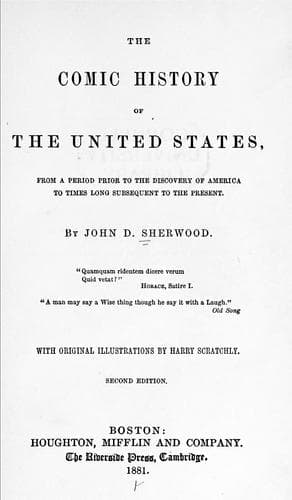
The comic history of the United States, from a period prior to the discovery of America to times long subsequent to the presentSherwood, John D.
History
The comic history of the United States, from a period prior to the discovery of America to times long subsequent to the present
Sherwood, John D.
United States -- History -- Humor
During January, 1861, Mississippi, Florida, Alabama, Georgia, and
Louisiana somehow did something, in some way, somewhere, by somebody,—as
did Texas in the month of February following,—which was claimed by the
head-and-tails party in the South, as indicating the popular conviction
that Sambo was the only proper object of care by Uncle Sam; that they
fancied from what they suspected that the Anak Abraham would not carry
their pet lamb in his bosom as it had been carried; and that therefore
the family was played out. These mysterious, inexplicable somethings, by
somebody, somewhere and somehow, were gravely labelled “Ordinances of
Secession.” Certain it is, that in not one of these States, except in
Texas, were the people consulted about or called to ratify these very
grave resolves. Having only three months before voted against their
incarnation,—the prize-taker,—it is to be presumed that they would hold
to the same beliefs still, in the absence of any act or deed on the part
of the Anak to induce a change of opinion.
The uncomic truth is, that in this case, as in so many others which have
occurred or are occurring in our political history, these overwhelmingly
large questions—upon which hang so many lives, so much happiness or
suffering, such accumulated stores of hard-earned savings and
character—were undertaken to be answered by a few cunning, selfish,
dishonest, narrow-headed politicians, audaciously presuming upon what
they ignorantly called leadership,—in the absence of men engaged in more
honest work, of clearer head and better instincts,—who, idle hands in a
country where all just men are busy, too proud to work, too poor to live
without the proceeds of others’ labor, ever restless and intriguing for
luxurious places and foremost positions, find that, by getting up a
strike, they can preside, officer, talk to, and become prominent at
assemblages of arrested workmen, and live from their accumulated fund.
Disturbed, as well they might be, by these mysterious ordinances, forged
by these mischievous idlers, an assemblage of white-headed and unwisely
patriotic gentlemen met at Washington to get rid of them. Ordnance would
undoubtedly have affected it, but ordnance was not to be thought of by
those who were recommending cotton-sprouts and hopelessly tramping after
fire-flies.
Some of the Southern Senators gathered up their dark robes, and loftily
chaffing their Northern associates, strode from the chamber.
There was no ordnance in Washington. Of course John C. Breckenridge did
not yet follow them; it was more profitable to him and the ordinance
parties to stay.
John B. Floyd dispersed our little army of 16,000 men into small squads
far away from the ordnance-makers. He knew that the cotton-sprouts would
grow better unshaded by bayonets. On land there was no ordnance where it
was needed.
Public-domain text, read in full here on John Shaqi.
Reviews
Reviews
No reviews yet
Be the first to share your thoughts on this work.
Elsewhere in the archive
Join the Discussion
Join the discussion
Sign in to leave a comment or review.
Sign InorCreate an account