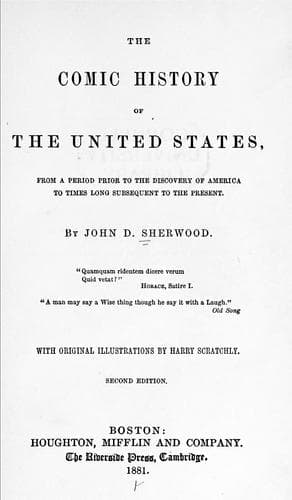
The comic history of the United States, from a period prior to the discovery of America to times long subsequent to the presentSherwood, John D.
History
The comic history of the United States, from a period prior to the discovery of America to times long subsequent to the present
Sherwood, John D.
United States -- History -- Humor
General Robert Anderson, of Southern birth, was, in the autumn of 1860,
assigned to Charleston Harbor, and there left with only 80 men to the
presumed magnetic attractions of that affirmative place. To these his
patriotism declined to be drawn. December 26, 1860, he removed from Fort
Moultrie to Sumter, two miles farther off from the magnets. For eight
months preceding, Mr. Floyd had sent heaps of muskets and ammunition, as
desirable compost for the cotton-sprouts. Isaac Toucey, of Hartford,
Connecticut, of a cold temperament, and from a cool latitude, thought
the health of naval officers might suffer from the heats of Charleston,
Wilmington, Savannah, St. Augustine, Mobile, and New Orleans, and so
ordered our ships to rove in distant seas.
There was, therefore, no ordnance off the seaboard.
The little garrison at Fort Sumter now became the pivot of the Union.
Around the question of its reinforcement the Cabinet swung and went to
pieces. General Cass, who had broken his sword before surrendering it to
those who sought to prevent our Union, now broke his heart over the
attempts of those who sought to shiver it in pieces. He was succeeded by
Jeremiah S. Black, a gentleman devoted to the black family when
enchained, indifferent to them when free. Floyd, one of the ring-leaders
in the strike, skedaddled to Virginia, followed in his rapid journey by
an indictment for having connived at the withdrawal of $870,000 worth of
bonds from Jacob Thompson’s loosely managed Interior. His place was
taken by the unbelieving Thomas, of Maryland, who soon became tangled by
his want of faith, and was succeeded by General Dix, who had more
confidence in guns than in Dixie.
[Illustration:
THE SKEDADDLE OF JOHN B. FLOYD.
(p. 461)
]
On the 4th of February, 1861, the en-gulfed States and South Carolina
sent some delegates—chosen also somehow, somewhere, by somebody, in some
way unknown—to Montgomery, Alabama, to a convention, where the leading
strikers of course got upon the platform, and had the principal chairs.
They proceeded forthwith to concoct that first-class patent medicine for
all supposed ills, a constitution. In the composition of this draught
_radex Africanus_ largely entered. It was to be poured out by slaves,
and taken every waking hour. A separate government, called the
Confederate, was set up by these somehow delegates.
A flag was also devised, not in consonance with the avowed object of its
bearers, namely,—a colored man saddled and running like an unpaid,
tireless velocipede with a white rider in the seat working its shackled,
eccentric way,—but with stars and bars,—stars rayless as night, and bars
destined to be very sinister to the Southern hopes, and eventually to be
leaped and beaten down by spirited Northern trampers.
Public-domain text, read in full here on John Shaqi.
Reviews
Reviews
No reviews yet
Be the first to share your thoughts on this work.
Elsewhere in the archive
Join the Discussion
Join the discussion
Sign in to leave a comment or review.
Sign InorCreate an account