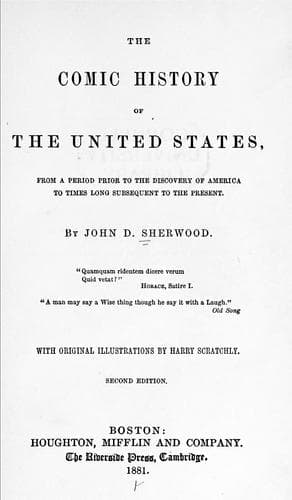
The comic history of the United States, from a period prior to the discovery of America to times long subsequent to the presentSherwood, John D.
History
The comic history of the United States, from a period prior to the discovery of America to times long subsequent to the present
Sherwood, John D.
United States -- History -- Humor
To be President of this African Commonwealth, the mysteriously elected
delegates invited J. Davis, who was as ready to say yes as the old maid
who had done the courting for a series of years. Of a metaphysical turn
of mind,—a turn around which all State rights arguments wind themselves
up,—sharp-visaged, lean of muscle, leaner of conscience, and leanest of
veracity, he had, after being educated at the government expense at West
Point, tracked office with a faultless scent, shown much pluck during
the Black Hawk and Mexican wars, gnawed the bone of repudiation in
Mississippi, and was now ready to bay at Federal flocks wherever they
appeared. Like John Brown, Stonewall Jackson, and those hard Scotch
fighters who prayed before the direst slaughters, he was most devout
just before writing those calm-looking, philosophy-streaked messages,
which massacred truth with a glaived hand, and shamed fiction by the
recital of atrocities which had no foundation, except at Andersonville
and in the Libby Prison at Richmond.
While these active heats were raging on the edges of the government,
cold chaos brooded at the centre. Through the rank growth of cotton,
threatening to overtop everything national, only fire-flies still.
At last the weary days vanished. Fourth of March came, and Mr. B. went
away—to his own place.
CHAPTER XVIII.
OUR NEWER NATIONAL ALBUM.
The Second Generation of our Great Men nearer in Time but not in
Affection.—Several sufficient Reasons therefor.—Ingenious Biographers
confusing our Verdicts over old Offenders.—A Latin Quotation to prove
an Original Remark.—Why we should not stick to old Opinions.—Sketches
of Clay, Calhoun, and Webster.—Parallels do not always run at equal
Distances.—Three Fates.—Original Anecdote of Webster.—Of Lewis Cass
and Thomas H. Benton.—Why double-chinned Persons are satisfactory.—The
Plutocrats Girard and Astor; how they made Fortunes, and how
much.—John Marshall as a Judge, and John Trumbull as a Painter.—Albert
Gallatin skims American Cream.—Rembrandt Peale and Washington Allston
described.—Why Felix Grundy, S. S. Prentiss, J. J. Crittenden, Samuel
Houston, D. D. Tompkins, and Others, were like Shoots grafted upon
hardy Native Stocks.—The Senate illuminated by J. M. Berrien, S. L.
Southard, W. C. Preston, etc., Legaré, and Butler.—A full-length
Portrait of Winfield Scott.—Irving delineated.—Drake, Halleck, and
Paulding.—Fenimore Cooper descanted upon.—Science illustrated by
Silliman, Hare, and Rush.—Descriptions of Prescott, Mrs. Sedgwick,
Greenough, and Hawthorne.—How well the Second Set persuaded the
Eighteenth Century over into the Nineteenth.
Public-domain text, read in full here on John Shaqi.
Reviews
Reviews
No reviews yet
Be the first to share your thoughts on this work.
Elsewhere in the archive
Join the Discussion
Join the discussion
Sign in to leave a comment or review.
Sign InorCreate an account