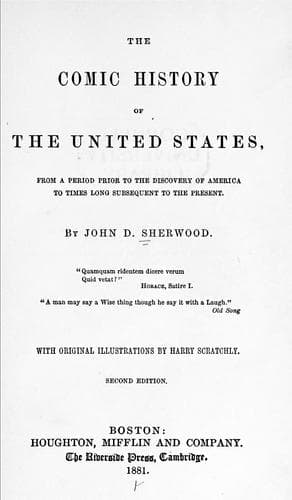
The comic history of the United States, from a period prior to the discovery of America to times long subsequent to the presentSherwood, John D.
History
The comic history of the United States, from a period prior to the discovery of America to times long subsequent to the present
Sherwood, John D.
United States -- History -- Humor
The cotton-gin struck, in 1793, springs all over the slave States, whose
multiplying flows so gathered head in 1821 as to require damming back.
The Missouri dike was erected. The pent waters, however, were found so
profitable for foreign mill-owners, for over-shot feeders to Northern
shelves, for commercial pockets, and political ballot-boxes, as well as
such wealth-distributing streams over the growing breadths and easy
luxuries of their Southern owners, that expedients were devised to swell
their volume, area, and back-water power. The dike, cut in 1854, let out
the accumulated deluge into new sluice-ways, which promised to some
increased profits, but which produced great ravages in many ways, and at
last set towards maelstroms, down whose gurgling throats were sucked,
not only the passive and floating citizen, and the compromising, timid
politician, but much of the life and wealth of the nation at large.
Over the angry ridges, rapidly rising on the 4th of March, 1861, Mr.
Lincoln, uneasy at the white caps crisping the dark swells, and himself
in disguise, landed at the national wharf in Washington. Without
disguise, however, he at once, in a distinct, calm voice, announced the
principles upon which he proposed to meet the menacing flood, namely,
not to interfere with its black tides in States where they were legally
channelled, nor to create any new courses in Territories in which they
had not surged, and steadily to enforce, in spite of all obstructions,
the existing rules, regulations, and laws both North and South.
[Illustration:
COTTON SUPREME.
(p. 483)
]
This announcement struck the knob of the national shield, and its
metallic notes quivered through the air. The three commissioners,
despatched from the somehow gathered Confederate assemblage at
Montgomery, heard the vibrations the morning of their arrival, March
5th, but failed to shout loud enough to be heard themselves, and
returned speedily with their cross-barred message.
Public-domain text, read in full here on John Shaqi.
Reviews
Reviews
No reviews yet
Be the first to share your thoughts on this work.
Elsewhere in the archive
Join the Discussion
Join the discussion
Sign in to leave a comment or review.
Sign InorCreate an account