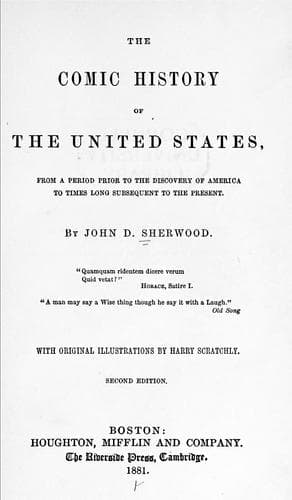
The comic history of the United States, from a period prior to the discovery of America to times long subsequent to the presentSherwood, John D.
History
The comic history of the United States, from a period prior to the discovery of America to times long subsequent to the present
Sherwood, John D.
United States -- History -- Humor
Through the evening silences which followed the evacuation of Fort
Sumter, April 14, 1861, were heard at Montgomery and in other
Confederate cities rhetorical voices of gratulation at the humbled
pride, flag, and prosperity of the North, and predictions of bold
equestrian sallies into Washington, Philadelphia, New York, and Boston;
at the North, wails of sorrow, sudden questions of the causeless blows
on the tingling national cheek, mixed with remorseful self-accusations
at the weak petting, which had so encouraged unrestrained tempers as to
invite to this public breaking of the family crockery and this
unconcealable family disgrace. “Had not the rod been so long
spared,”—was the general feeling,—“we should now be spared the use of
the ramrod.” The next morning, however, Mr. Lincoln proclaimed the need
of seventy-five thousand ramrods, with good men to accompany them to
Washington. At the same time he asked the wise men to meet at the
capital in July for consultation. Ere the next daybreak, a thousand
Massachusetts lads were on their way towards the Potomac, shining in
new-burnished steel and new polished love for that old Union mother,
whose goodness had been so steady and uniform as hitherto to excite no
manifested return. On the 19th of April they reached Baltimore, and were
passing through in the horse-cars, when they were set upon by a bad lot
of hards and softs of that city,—as others before and since have
frequently been assailed in their transit, by railway and hotel runners.
Other regiments soon followed from “the teeming North, through all her
unfrozen loins.” Guns were got down from rusted hooks; shoulder-straps
straightened; blunderbusses and other busses given and taken; officers
beaten up from behind ploughshares to be beaten in first skirmishes into
good leaders; and shields from all the free States were clasped around
the waist of the capital. Never were there so many gun-holders, nor so
few office-seekers, at Washington in the month of April.
The soft velveted hand which caressed was now stiffened into the steel
gauntlet to smite.
Meanwhile the English government, employed since 1783 in looking across
at us through the large end of its telescope, suddenly got its eye at
the other extreme, and discovered the monstrous size of this country,
the large population, and unmanifested pluck of the nine somehow seceded
States, and, to her, the very obvious absence of any ties or mutual
necessity between two such admirably designed single nations. This was
the almost unanimous opinion, too, of the well-dressed classes; although
some Bright Englishmen, and especially the hard toilers in the
manufacturing districts,—although working in smoke,—saw more clearly the
object and design as well as the final end of the commencing difficulty
than those whose near-sightedness spread a film over all their American
observations.
“The Hunited States ’ave too many people,” said Lord John.
“Haltogether, yes,” replied Lord Palmerston.
Public-domain text, read in full here on John Shaqi.
Reviews
Reviews
No reviews yet
Be the first to share your thoughts on this work.
Elsewhere in the archive
Join the Discussion
Join the discussion
Sign in to leave a comment or review.
Sign InorCreate an account