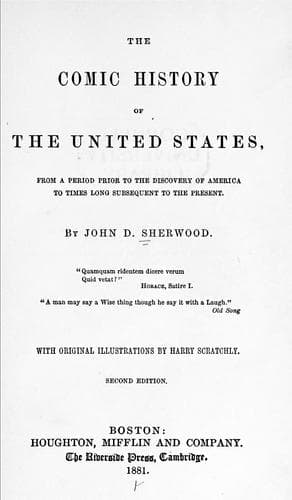
The comic history of the United States, from a period prior to the discovery of America to times long subsequent to the presentSherwood, John D.
History
The comic history of the United States, from a period prior to the discovery of America to times long subsequent to the present
Sherwood, John D.
United States -- History -- Humor
“Suppose that they should fight?” inquired Lord John.
“Well, two heads are better than one,” replied the facetious Palmerston.
“And so are two customers,” rejoined Lord John, wiping his nose with a
cotton pocket-handkerchief.
And forthwith they issued a proclamation of neutrality in the name of
the Queen, whose heart was no more in its sentiments than her hand in
its composition. It was thought at the time by many people to be very
smart; and so it was very smart, altogether too smart. It was a state
fiction,—a fancy creation, looking in legal phrase as if all the English
were bent on rushing into the prophesied something,—a buffalo-hunt, a
Long Island race, or steamboat explosion;—for what the little flurry was
about, or would be when the solemn state warning was given, no one
knew,—unless they were violently restrained by the British government.
It was the unnecessarily vehement declaration of the very disinterested
old maid to the unsuspecting, quiet young man, quite innocent of such
audacious thoughts as her fears excited and suggested: “Now, if you kiss
me I shall resist. I shall. Don’t you try it. Now, there, don’t come
towards me. Don’t make such a noise, for everybody will hear you. Hands
off. Don’t try it. I shall scream. Quit now. Don’t disturb the
neighborhood. Hands off, I tell you. I won’t have anything to do with
it.” The warning was as piquant and promotive of the practice
deprecated, as the landlord’s to the ostler, never to grease the teeth
of traveller’s horses, for if he should they could not eat oats.
The strikers in Arkansas and North Carolina, in May, contrived somehow
to get up delegates to meet those from the other Southern States at
Richmond, the newly selected gathering-place of Confederated
counsellors.
The insurrection commenced to grow. The warned boy began seriously to
think of the audacity from which he was so solemnly conjured to desist.
Federal war stores, magazines, and naval materials were handed over to
the new State claimants by their loose-wristed custodians, who, although
educated by the Federal government, generously gave away her property on
the principle of that testator, who requested his own debtors, forthwith
after his decease, to pay what they owed to his executors, and nobly
forgave his creditors the debts which he owed them. Floydism became as
fashionable South as cotton, butternut-colored clothing and long hair.
Just as the tree was bent the Twiggs inclined. At Little Rock,
Pensacola, Portsmouth, Virginia, and in Texas, large masses of stores,
cannon, guns, and naval materials were transferred, like the allegiance
of the officers in charge, to the strange African fetich. It looked as
if the American people were moving out of the lower story of their
large, constitutional bazaar into the upper lofts, and were giving away
generously a part of the expensive fixtures to the new incoming tenant.
Public-domain text, read in full here on John Shaqi.
Reviews
Reviews
No reviews yet
Be the first to share your thoughts on this work.
Elsewhere in the archive
Join the Discussion
Join the discussion
Sign in to leave a comment or review.
Sign InorCreate an account