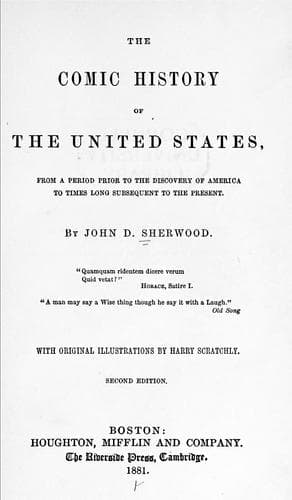
The comic history of the United States, from a period prior to the discovery of America to times long subsequent to the presentSherwood, John D.
History
The comic history of the United States, from a period prior to the discovery of America to times long subsequent to the present
Sherwood, John D.
United States -- History -- Humor
On the 29th of May the new President commenced the Sisyphus business of
Southern reconstruction; first rolling to the top of the hill the stone
of a provisional government for North Carolina, which, of course, rolled
back again, covered by the old shells of the Confederacy. By the middle
of July he had tugged up the same stone under different names, as
Mississippi, Georgia, Texas, Alabama, Florida, and South Carolina, only
to find it rolling down speedily, hurting the colored people and Union
whites, and creating a butternut-colored atmosphere all around it. The
entertainment was too often repeated to be jocose, except to Mr.
Johnson, who believed in a detached idea industriously pursued. The
delegates to Congress under his scheme, who presented themselves at
Washington, in December, 1865, were found to be all of the saffron
complexion and hue. They had already forgotten that there had been any
war, and only remembered their ancient rights, and were ready to draw
back pay, or anything else back, except declarations of not having been
in the least wrong in the late little unpleasantness. Congress read
their own privileges, rights, and duties in quite a different way;
declared their exclusive right, as representatives of the people, to
deal with the new puzzles; passed the Freedmen’s Bureau Bill for the
protection of the colored property of the South, the Civil Rights Bill,
and the proposed Fourteenth Constitutional Amendment. While they
believed in the dead past burying its dead, they did not embrace the
idea of its burying the living with them.
Mr. Johnson now studied the Art of Vetoing Made Easy; and from his
cross-readings began to add immensely to the American official archives
by Xanthippe messages, whose unlovely words have greatly embossed the
rich cabinets of vituperative specimens, for a long time accumulating at
Washington.
[Illustration:
THE IRISH REPUBLIC IN AMERICA.
(p. 529)
]
In July, 1866, a riot was created in New Orleans,—the counterpart of the
pat-riot disturbances in New York three years before,—in which
thirty-four loyal colored and three loyal colorless people were added to
the Crescent cemeteries. The citizens who had participated in the
bonfires and illuminations, on the arrival of Farragut and Porter in
1862 were mercifully spared. In August following, the acting President,
accompanied by Mr. Seward,—whose wonderful pen through the silent
diplomatic struggle abroad, which ran parallel with the armed strife at
home, cannot be alluded to with scant praise,—set out for Chicago, to
lay the corner-stone of a monument to the powerful dike-breaker. Never
was a journey so long. The road thither seemed to have got intoxicated
and reeled and tumbled all over the West; while the jerky speeches,
hiccuping along the wavy ways, endeavored in vain to catch up with and
to find the President.
Public-domain text, read in full here on John Shaqi.
Reviews
Reviews
No reviews yet
Be the first to share your thoughts on this work.
Elsewhere in the archive
Join the Discussion
Join the discussion
Sign in to leave a comment or review.
Sign InorCreate an account