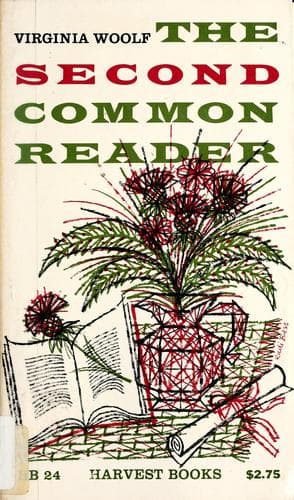
English literature -- History and criticism; Literature, Modern -- History and criticism
close our eyes, for a servant sobbing or the touch of a hand would break
us down. Best of all, let death find us at our usual occupations, among
girls and good fellows who make no protests, no lamentations; let him
find us “parmy les jeux, les festins, faceties, entretiens communs et
populaires, et la musique, et des vers amoureux”. But enough of death;
it is life that matters.
It is life that emerges more and more clearly as these essays reach not
their end, but their suspension in full career. It is life that becomes
more and more absorbing as death draws near, one’s self, one’s soul,
every fact of existence: that one wears silk stockings summer and
winter; puts water in one’s wine; has one’s hair cut after dinner; must
have glass to drink from; has never worn spectacles; has a loud voice;
carries a switch in one’s hand; bites one’s tongue; fidgets with one’s
feet; is apt to scratch one’s ears; likes meat to be high; rubs one’s
teeth with a napkin (thank God, they are good!); must have curtains to
one’s bed; and, what is rather curious, began by liking radishes, then
disliked them, and now likes them again. No fact is too little to let it
slip through one’s fingers and besides the interest of facts themselves,
there is the strange power we have of changing facts by the force of the
imagination. Observe how the soul is always casting her own lights and
shadows; makes the substantial hollow and the frail substantial; fills
broad daylight with dreams; is as much excited by phantoms as by
reality; and in the moment of death sports with a trifle. Observe, too,
her duplicity, her complexity. She hears of a friend’s loss and
sympathises, and yet has a bitter-sweet malicious pleasure in the
sorrows of others. She believes; at the same time she does not believe.
Observe her extraordinary susceptibility to impressions, especially in
youth. A rich man steals because his father kept him short of money as a
boy. This wall one builds not for oneself, but because one’s father
loved building. In short the soul is all laced about with nerves and
sympathies which affect her every action, and yet, even now in 1580, no
one has any clear knowledge—such cowards we are, such lovers of the
smooth conventional ways—how she works or what she is except that of
all things she is the most mysterious, and one’s self the greatest
monster and miracle in the world. “. . . plus je me hante et connois,
plus ma difformité m’estonne, moins je m’entens en moy.” Observe,
observe perpetually, and, so long as ink and paper exist, “sans cesse et
sans travail” Montaigne will write.
Public-domain text, read in full here on John Shaqi.
Reviews
Reviews
No reviews yet
Be the first to share your thoughts on this work.
Join the Discussion
Join the discussion
Sign in to leave a comment or review.
Sign InorCreate an account