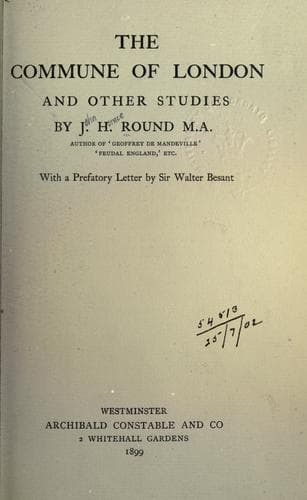
The Commune of London, and other studiesRound, John Horace
History
The Commune of London, and other studies
Round, John Horace
Great Britain -- History -- Norman period, 1066-1154; London (England) -- History -- To 1500
When, in the crisis of October, 1191, the administration found itself
paralysed by the conflict between John, as the king’s brother, and
Longchamp, as the king’s representative, London, finding that she held
the scales, promptly named the “Commune” as the price of her support.
The chroniclers of the day enable us to picture to ourselves the scene,
as the excited citizens who had poured forth overnight, with lanterns
and torches, to welcome John to the capital, streamed together on the
morning of the eventful 8th October, at the well-known sound of the
great bell, swinging out from its campanile in St. Paul’s churchyard.
There they heard John take the oath to the “Commune,” like a French
king or lord; and then London for the first time had a municipality of
her own.
This much at least we may deem certain; but what the chroniclers tell
us has proved to be only enough to whet the appetite for more. Of the
character of the “Commune” so granted, of its ultimate fate, and of
the part it played in the municipal development of London, nothing
has been really known. The only fact of importance ascertained from
other sources has been the appearance of a Mayor of London at or
about the same time as the grant of a “Commune.” It cannot, indeed,
be proved that, as has sometimes been supposed, the two phenomena
were synchronistic; for no mention of the Mayor of London, after long
research, is known to me earlier than the spring of the year 1193.[472]
But there is, of course, the strongest presumption that the grant of
a “Commune” involved a Mayor, and already in 1194 we find a citizen
accused of boasting that “come what may, the Londoners shall have no
king but their Mayor.” It was precisely in the same spirit that the
‘Comuneros’ of Salamanca exclaimed of their leader in 1521: “Juras à
Dios no haber mas Rey ni Papa que Valloria.”
Before I explain my discoveries on the “Commune” granted to London,
it may be desirable to show how great a discrepancy of opinion has
hitherto prevailed on this important but admittedly obscure subject.
The first historian, so far as I know, to treat the subject in the
modern spirit was the present bishop of Oxford; and it is a striking
testimony to his almost infallible judgment that what he wrote on the
subject a quarter of a century ago is the explanation that, to this
day, has held the field. In his ‘Select Charters’ (1870), he expressed
the view that
Public-domain text, read in full here on John Shaqi.
Reviews
Reviews
No reviews yet
Be the first to share your thoughts on this work.
Elsewhere in the archive
Join the Discussion
Join the discussion
Sign in to leave a comment or review.
Sign InorCreate an account