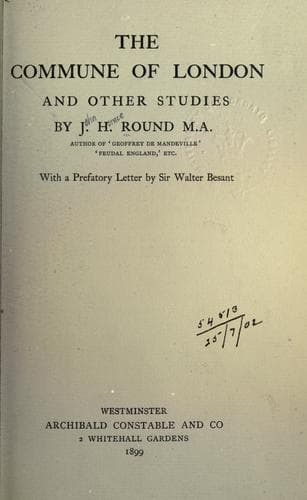
The Commune of London, and other studiesRound, John Horace
History
The Commune of London, and other studies
Round, John Horace
Great Britain -- History -- Norman period, 1066-1154; London (England) -- History -- To 1500
the establishment of the ‘Communa’ of the citizens of London,
which is recorded by the historians to have been specially
confirmed by the Barons and Justiciar on the occasion of
Longchamp’s deposition from the Justiciarship is a matter of
some difficulty, as the word ‘Communa’ is not found in English
town charters, and no formal record of the act of confirmation
is now preserved. Interpreted, however, by foreign usage, and
by the later meaning of the word ‘communitas,’ it must be
understood to signify a corporate identity of the municipality,
which it may have claimed before, and which may even have been
occasionally recognised, but was now firmly established; a sort
of consolidation into a single organized body of the variety of
franchises, guilds, and other departments of local jurisdiction.
It was probably connected with and perhaps implied by the
nomination of a _Mayor_, who now appears for the first
time. It cannot, however, be defined with certainty (p. 257).
And in his ‘Constitutional History’ he holds that it practically “gave
completeness to a municipal constitution which had long been struggling
for recognition.” These comments, on the whole, suggest rather a
development of existing conditions than the introduction of a foreign
institution.
Mr. Coote, the next to approach the subject, contended that Dr. Stubbs’
“view falls very far short of the reality.” In his able paper “A
Lost Charter,”[473] he insisted that a charter was actually granted
in 1191 to the Londoners empowering them to elect a Mayor, and that
this is what the chroniclers meant when they spoke of the grant of
“Commune,” for the citizens, he urged, had possessed all the rights of
a “Commune” from the days of the Conqueror. With Mr. Loftie’s work came
the inevitable reaction. Wholly ignoring the definite and contemporary
statement as to the grant of a “Commune,” he deemed it “far safer
to adopt the received and old-fashioned opinion,” and to date the
Mayoralty from 1189, while, as for the “Commune,” he deemed it to have
been of gradual growth, and to have been practically recognised by the
charter of Henry I.
Public-domain text, read in full here on John Shaqi.
Reviews
Reviews
No reviews yet
Be the first to share your thoughts on this work.
Elsewhere in the archive
Join the Discussion
Join the discussion
Sign in to leave a comment or review.
Sign InorCreate an account