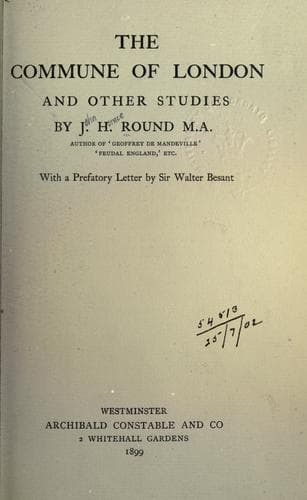
The Commune of London, and other studiesRound, John Horace
History
The Commune of London, and other studies
Round, John Horace
Great Britain -- History -- Norman period, 1066-1154; London (England) -- History -- To 1500
Now, whatever the grant of “Commune” implied, it certainly implied
something, and something of importance. “Upon this point there is,”
as Mr. Coote justly observed, “a cloud of contemporary evidence,
clear, exact and positive.” He put together the versions of the
chroniclers,[474] contemporary and well-informed, and their harmony is
complete. The fact, moreover, that the Commune was extorted at a great
crisis, proved that only when the government was weak could so great a
concession be wrung from it. Lastly, the phrase of Richard of Devizes:
“Concessa est ipsa die et instituta Communia Londinensium,” and that
of Giraldus: “Communa seu Communia eis concessa,” correspond exactly
with the formal phrases in the French charters of “Commune.” In the
case of Senlis (1173) it was “Communiam fieri concessimus”; in that of
Compiègne (1153): “Burgensibus villæ concessimus Communiam”; in that
of Abbeville (1185) “concessi eis Communiam habendam”; in that which
Queen Eleanor granted to Poitiers (1199): “Sciatis nos concessisse ...
universis hominibus de Pictavi et eorum heredibus communiam juratam
apud Pictavim.” But if any doubt were yet possible, it would be finally
removed by the words of Richard of Devizes:
Nunc primum, indulta sibi conjuratione, regno regem deesse
cognovit Londonia, quam nec rex ipse Ricardus nec prædecessor
et pater ejus Henricus pro mille millibus marcis argenti fieri
permississet.
There is no escaping from these words, and Mr. Loftie’s theory is,
consequently, out of court.[475]
But what of Mr. Coote’s? With great confidence he wrote that the
“Commune,” in the case of London, which had acquired all other things,
expressed for its citizens the mayoralty only; “nothing else was asked
or desired by them, for it was the sole privilege which was wanting
to their burghal independence” (p. 287). We find, however, that on
the Continent the word ‘Commune’ did not of necessity imply a Mayor,
for Beauvais and Compiègne, though constituted ‘Communes,’ appear to
have had no Mayor during most of the 12th century. The chroniclers,
therefore, had they only meant to speak of the privilege of electing
a Mayor, would not have all employed a word which did not connote it,
but would have said what they meant. Moreover, his theory rests on the
assumption, common till now to all historians, that the citizens had
continuously possessed, from the beginning of the 12th century, the
privileges granted in the charter of Henry I. But I have shown, in my
‘Geoffrey de Mandeville,’ that these privileges were not renewed by
Henry II. or Richard I., and that this fact strikingly confirms the
explicit words of Richard of Devizes, when he states that neither the
one nor the other would have allowed the Londoners to form a ‘Commune’
even for a million of marcs.
Public-domain text, read in full here on John Shaqi.
Reviews
Reviews
No reviews yet
Be the first to share your thoughts on this work.
Elsewhere in the archive
Join the Discussion
Join the discussion
Sign in to leave a comment or review.
Sign InorCreate an account