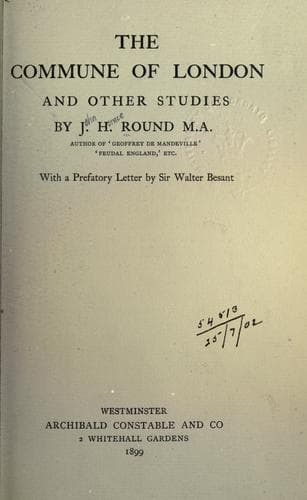
The Commune of London, and other studiesRound, John Horace
History
The Commune of London, and other studies
Round, John Horace
Great Britain -- History -- Norman period, 1066-1154; London (England) -- History -- To 1500
(II). De centum vero paribus eligentur viginti quatuor, assensu
centum parium, qui singulis annis removebuntur; quorum duodecim
eschevini vocabuntur, et alii duodecim consultores. Isti viginti
quatuor, in principio sui anni, jurabunt se servaturos jura
sancte ecclesie et fidelitatem domini regis atque justiciam quod
et ipse recte judicabunt secundum suam conscienciam, etc.
LIV. Iterum, major et eschevini et pares, in principio sui
eschevinatus, jurabunt eque judicare, nec pro inimicitia nec pro
amicitia injuste judicabunt. Iterum, jurabunt se nullos denarios
nec premia capturos, quod et eque judicabunt secundum suam
conscienciam.
LV. Si aliquis juratorum possit comperi accepisse premium pro
aliqua questione de qua aliquis trahatur in eschevinagio,
domus ejus ... prosternatur, nec amplius ille qui super hoc
deliraverit, nec ipse, nec heres ejus dominatum in communia
habebit.
The three salient features in common are (1) the oath to administer
justice fairly, (2) the special provisions against bribery, (3) the
expulsion of any member of the body convicted of receiving a bribe.
If we had only “the oath of the Commune,” we might have remained in
doubt as to the nature of the administrative body; but we can now
assert, on continental analogy, that its twenty-four members comprised
twelve “skevini” and an equal number of councillors. We can also assert
that it administered justice, even though this has been unsuspected,
and may, indeed, at first arouse question.
It will, naturally, now be asked: What became of these “twenty-four,”
who formed the Mayor’s council in the days of John? Mr. Loftie, we
have seen, held that they became “identified with the Aldermen”; my
own view is that, on the contrary, they were the germ of the Common
Council. The vital distinction to be kept in mind is that the Alderman
was essentially the officer in charge of a ward, while the Common
Council, as one body, represented the City as a whole. In questions
of this kind little reliance can be placed on late commentators; but
the _formulæ_ of oaths are usually ancient, and often enshrine
information on the duties of an office in the past. Now the oath of a
member of the Common Council contains significant clauses:
Sacramentum ... hominum ad Commune Consilium electorum est tale:
... bonum et fidele consilium dabis, secundum sensum et scire
tuum; et pro nullius favore manutenebis proficium singulare
contra proficium publicum vel commune dictæ civitatis; et
postquam veneris ad Commune Consilium, sine causa rationabili
vel Majoris licentia non recedes priusquam Major et socii sui
recesserint; et quod dictum fuerit in Communi Consilio celabis,
etc.[499]
Public-domain text, read in full here on John Shaqi.
Reviews
Reviews
No reviews yet
Be the first to share your thoughts on this work.
Elsewhere in the archive
Join the Discussion
Join the discussion
Sign in to leave a comment or review.
Sign InorCreate an account