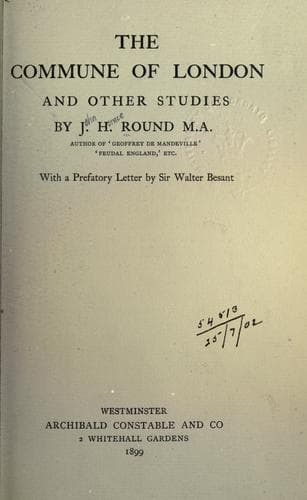
The Commune of London, and other studiesRound, John Horace
History
The Commune of London, and other studies
Round, John Horace
Great Britain -- History -- Norman period, 1066-1154; London (England) -- History -- To 1500
It is not only that this is essentially the oath of one whose
function it is to be a councillor: the striking point is that it
contains three provisions in common with those which bound, at Rouen,
the “Vingtquatre.” The councillor was (1) not to be influenced by
private favour; (2) not to leave the Council without the Mayor’s
permission;[500] (3) to keep secret its proceedings.[501] I do not
say, of course, that there is verbal concordance; but when we turn to
the oath of the Alderman, we see at once how much less resemblance his
duties have to those of the “Twenty-four.”[502] It presents him as
primarily the head of a Ward, responsible for certain matters within
the compass of that Ward. He has to take part with the Mayor in assize,
pleas, and hustings;[503] but his functions as councillor obtain only a
brief mention in his oath (“et que boun et loial conseil durrez a ley
choses touchantz le comune profit en mesme la citee”).
If any doubt is felt on the subject, it should be removed by turning to
the case of Winchester. There, as in London, according to the ancient
custumal of the city, we find the Mayor closely associated with a
council of “Twenty-four,” which, in that case, continued to exist down
to 1835:
Il iert en la vile mere eleu par commun assentement des vint et
quatre jures et de la commune ... le quel mere soit remuable de
an en an ... Derechef en la cite deivent estre vint et quatre
jurez esluz des plus prudeshommes e des plus sages de la vile e
leaument eider e conseiller le avandit mere a franchise sauver
et sustener.[504]
It is clear, to me, that “the Twenty-Four” were no more elected by
the Wards (as is persistently believed) in London than at Winchester,
but by the city as a whole, though we must not define the Franchise.
The Winchester Aldermen, on the contrary, were distinctly district
officers, as in London, “whose functions related chiefly, but
not wholly, to the police and preservation of order, health, and
cleanliness within their several limits.”[505] Moreover, they retained
at Winchester, down to a late period, their distinct character and
existence. According to Dean Kitchin:
The aldermen, in later days the civic aristocracy, were
originally officers placed over each of the wards of the city,
and entrusted with the administration of it.... It was not till
early in the sixteenth century that they were interposed between
the mayor and the twenty-four men.[506]
Public-domain text, read in full here on John Shaqi.
Reviews
Reviews
No reviews yet
Be the first to share your thoughts on this work.
Elsewhere in the archive
Join the Discussion
Join the discussion
Sign in to leave a comment or review.
Sign InorCreate an account