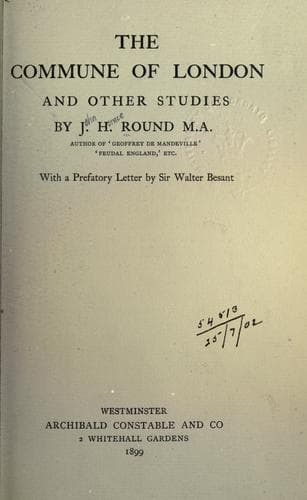
The Commune of London, and other studiesRound, John Horace
History
The Commune of London, and other studies
Round, John Horace
Great Britain -- History -- Norman period, 1066-1154; London (England) -- History -- To 1500
The general powers for the whole town possessed by the Mayor and his
council were quite distinct from the local powers of each Alderman in
his district. For my part, I cannot resist the impression that, while
the sheriff, bailiff, or reeve represented the power of the Crown,
and the Alderman the old local officer, the council of twenty-four,
so closely associated with the Mayor, and not the representatives of
districts, were a later introduction, of different character, and
representing the commercial as against the territorial element. Whether
the Aldermen joined the council in later days or not, they were never,
I believe, originally or essentially, a part of that body.
The chief objection, probably, to connecting the “commune” of London
with the “Établissements de Rouen” will be found in the fact that the
latter refer to a system based on a body of a hundred _pares_, of which
body there does not seem to be any trace in England. At Winchester
the _pares_ were “the twenty-four.” It is obvious that, in this
respect, there is a marked discrepancy; but if the electoral body was
different, the executive, at any rate, was the same. And if, as must be
admitted, there was a foreign element introduced, it would be naturally
from Normandy that it came.[507]
Writing in 1893, before I had discovered the documents on which I
have dwelt above, I insisted on the _foreign_ origin of the London
“commune,” and pointed out that the close association between London
and Rouen at the time suggested that the office of Mayor was derived by
the former from the latter.[508] It may be permissible to repeat this
argument from presumption, although its form was adapted to a wider
circle than that of scholars.
The _beffroi_ of France, to which the _jurat_ looked as the symbol
and pledge of independence, is found here also in the bell-tower
of St. Paul’s, which is styled in documents either by that name
(_berefridum_), or by that of _campanile_, which brings before us at
once the storm-tost commonwealths of Italy. It was indeed from Italy
that the fire of freedom spread. With the rise of mediæval commerce it
was carried from the Alps to the Rhine, and quickly burst into flame
among the traders and craftsmen of Flanders. Passing into Picardy, it
crossed the Channel, according to a theory I have myself advanced,
to reappear in the liberties of the Cinque Ports, with their French
name, their French “serements” and their French _jurats_.[509] Foreign
merchants had brought it with them to the port of Exeter also, almost
as early as the Conquest, and we cannot doubt that London as well was
already infected with the movement, and eager to find in the foreign
“commune” the means of attaining that administrative autonomy and
political independence which that term virtually expressed.
Public-domain text, read in full here on John Shaqi.
Reviews
Reviews
No reviews yet
Be the first to share your thoughts on this work.
Elsewhere in the archive
Join the Discussion
Join the discussion
Sign in to leave a comment or review.
Sign InorCreate an account