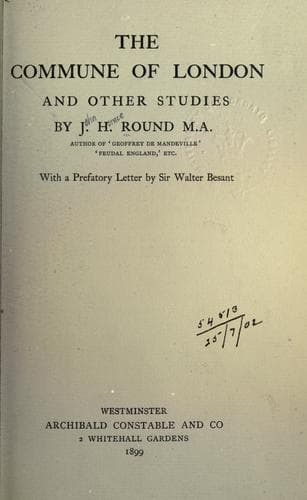
The Commune of London, and other studiesRound, John Horace
History
The Commune of London, and other studies
Round, John Horace
Great Britain -- History -- Norman period, 1066-1154; London (England) -- History -- To 1500
Bishop Mauger died in the very month of the Inquest (June, 1212).
The Notts and Derbyshire returns (p. 18) include two similar entries
relating to the archbishop of York, and those for Somerset and Dorset
contain two at least relating to the bishop of Bath (pp. 161 _b_, 162
_a_). The Sussex and Surrey returns similarly contain two entries
(p. 226 _a_) relating to Surrey churches to which the archbishop
of Canterbury had presented. In this last case the annual value of
the livings is deposed to, it should be noted, by six men of each
parish.[535]
Having now dealt with Middlesex and Worcestershire, I pass to
Lancashire, another county cited by Mr. Hall for comparison. The
magnificent return for this county in 1212[536] is noteworthy for
several reasons. In the first place, it is headed:
Hec est inquisicio facta per sacramentum fidelium militum
de tenementis datis et alienatis infra Limam in comitatu
Lancastrie, scilicet per Rogerum Gerneth, etc., etc.
This is a good illustration of the principle of “sworn inquest.” In
the second, it leads off with the entry: “Gilbertus filius Reinfri
tenet feodum unius militis.” Although this was a well-known man, _jure
uxoris_ a local magnate, the ‘Red Book’ text leads off with the gross
corruption: “Gilfridus filius Rumfrai i militem” (568). Mr. Hall,
in his index (p. 1183), identifies him with the “Galfridus filius
Reinfrei” of another ‘Red Book’ return (p. 599)--where the ‘Testa’ has,
rightly, “Gilbertus”--and fails to recognise in him the above Gilbert.
This is a striking comment on his views expressed at the outset as to
the inferiority of the ‘Testa’ text. So also is the fact that the ‘Red
Book’ reads “Thomas de Elgburgo” at the foot of the same page, where
the ‘Testa’ has “Thomas de Goldebur[go]” (p. 406), the correctness of
the latter reading being proved by the “Thomas de Goldeburgo” of the
‘Red Book’ itself (p. 69) in its extract from the Pipe Roll of 1187.
Yet the editor ignores the ‘Testa’ form, and gives ‘Elgburgo’ in the
Index.[537]
A third point is that the ‘Red Book’ compresses here into a skeleton
nearly thirteen columns of the closely printed ‘Testa de Nevill.’ The
text of the latter is of value not only for its wealth of information
and its witness to the detailed and far-reaching character of this
Inquest, but for such expressions as “pro herede Theobaldi Walteri qui
est in custodia sua” (_i.e._ regis). Theobald had died more than five
years before the Inquest was made; and yet in the ‘Red Book’ text he
appears as the living tenant.
This instance is of some importance in its bearing on apparent
contrasts in the ‘Testa’ and ‘Red Book’ versions. For Mr. Hall,
believing them to represent two successive returns, observes that
Public-domain text, read in full here on John Shaqi.
Reviews
Reviews
No reviews yet
Be the first to share your thoughts on this work.
Elsewhere in the archive
Join the Discussion
Join the discussion
Sign in to leave a comment or review.
Sign InorCreate an account