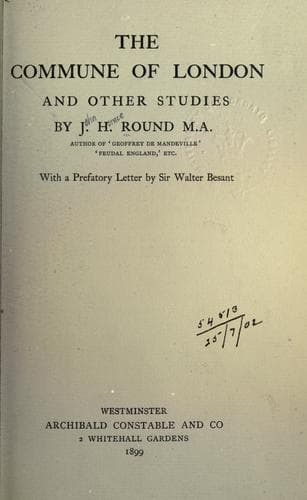
The Commune of London, and other studiesRound, John Horace
History
The Commune of London, and other studies
Round, John Horace
Great Britain -- History -- Norman period, 1066-1154; London (England) -- History -- To 1500
[24] “It is probable that all the primitive villages in whose name the
patronymic _ing_ occurs were originally colonized by communities
united either really by blood or by the belief in a common descent
(see Kemble)”--Stubbs (Const. Hist). “Harling abode by Harling and
Billing by Billing, and each ‘wick’ and ‘ham’ and ‘stead’ and ‘tun’
took its name from the kinsmen who dwelt together in it. In this way
the house or ham of the Billings was Billingham, and the township of
the Harlings was Harlington”--Green (‘Making of England,’ p. 188).
“Many family names appear in different parts of England.... Thus we
find the Bassingas at Bassingbourn.... The Billings have left their
stamp at Billing, in Northampton; Billingford, in Norfolk; Billingham,
in Durham; Billingley, in Yorkshire; Billinghurst, in Sussex; and
five other places in various other counties. Birmingham, Nottingham,
Wellington, Faringdon, Warrington, and Wallingford are well-known names
formed on the same analogy.... Speaking generally these clan names
are thickest along the original English coast, etc.”--Grant Allen
(Anglo-Saxon Britain,’ p. 43).
[25] “The German theory, formerly generally accepted, that free village
communities were the rule among the English, seems to have little
direct evidence to support it” (Social England, i. 125).
[26] Ibid. i. 130; cf. Canon Taylor: “The Saxon immigration was
doubtless an immigration of clans.... In the Saxon districts of the
island we find the names not of individuals, but of clans.”
[27] The exceptions that he admits are too slight to affect this
general statement.
[28] Stubbs, _ut supra_.
[29] Canon Taylor relies on the passage, “Ida was Eopping, Eoppa was
Esing,” etc.
[30] Saxons in England, i. 449–456, where he treats such names as
“Brytfordingas” as “patronymical.”
[31] Ed. 1888, p. 79.
[32] I do not overlook the possibility of ‘hall’ (_hala_) being
a subsequent addition (as in post-Domesday times), but in these cases
it was part of the name at least as early as the Conquest, and the
presumption must be all in favour of the name being derived from an
individual not from a clan.
[33] Saxons in England, i. 56.
[34] Ibid. i. 58 _et seq._
[35] “Hence we perceive the value of this word [_ing_] as an
instrument of historical research. For a great number of cases it
enables us to assign to each of the great Germanic clans its precise
share in the colonization of the several portions of our island.”
[36] Anglo-Saxon Britain, pp. 81–2.
[37] Heming or Haming was a personal name which occurs in Domesday, and
which has originated a modern surname.
[38] Even by Kemble, as in ‘Saxons in England,’ i. 60–79; but he terms
it a “slight” cause of inaccuracy.
Public-domain text, read in full here on John Shaqi.
Reviews
Reviews
No reviews yet
Be the first to share your thoughts on this work.
Elsewhere in the archive
Join the Discussion
Join the discussion
Sign in to leave a comment or review.
Sign InorCreate an account