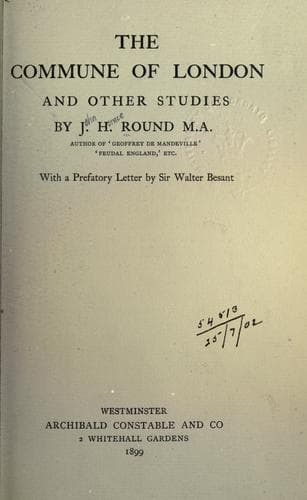
The Commune of London, and other studiesRound, John Horace
History
The Commune of London, and other studies
Round, John Horace
Great Britain -- History -- Norman period, 1066-1154; London (England) -- History -- To 1500
[39] ‘Wihtmund minister’ is found in 938 (Earle’s ‘Land Charters,’ p.
326), and ‘Widmundesfelt’ in the earliest extant Essex charter (Ib.
p. 13). It is, therefore, amazing that Professor Earle, dealing with
the phrase “æt Hwætmundes stane” (Ib. p. 317), should have gone out of
his way to adopt a theory started by Mr. Kerslake in the ‘Antiquary,’
connecting it with the “sculptured stone in Panier Alley,” writing:
“If now the _mund_ of ‘Wheatmund’ might be this _mand_ [basket], then
_hwætmundes stane_ would be the stone of the wheatmaund, and the
‘antiquum petrosum ædificium’ may have been the block of masonry that
was once the platform or basis of a market cross which had become
the usual pitching-place of cereal produce” (Ib. p. 318). This is an
admirable instance of that perverse Folk-etymology which has worked
such havoc with our place-names. Morant’s derivation in the last
century of ‘Widemondefort,’ from ‘a wide mound,’ is comparatively
harmless in its simplicity.
[40] Calendar of Bodleian Charters, p. 80.
[41] ‘Ac’ was the Domesday equivalent of ‘oak.’
[42] Dorset Domesday, p. 57.
[43] So Kemble derived it from the “Færingas.”
[44] Saxons in England, i. 63.
[45] Saxons in England, i. 475.
[46] I have shown (‘Feudal England,’ 103–106) that the _solanda_ of
other counties is not (as Seebohm thought, following Hale) in any way
the same as the _sulung_.
[47] See Earle’s ‘Land Charters,’ pp. 18, 24, 33, 49, 51, 54, 58, 60,
75, 78, 80, 82, 87, 95, 96, 100, 105, 124, 126, 133, 142, 152, 209.
[48] Ibid. pp. 4, 5, 7, 10, 12, 13, 15, 16, 20–24, 26, 29, 31, 40, 45,
etc.
[49] Feudal England, pp. 421 _et seq._
[50] English Historical Review, xi. 740, 741.
[51] Norm. Conq., iv. 56–7.
[52] According to the Peterborough Chronicle, he gave 40 marcs for this
reconciliation.
[53] Norman Conquest, vol. iv., App. C.
[54] The italics are mine.
[55] English Historical Review, xii. 109, 110.
[56] Ibid.
[57] 5th Report Hist. MSS., i. 452.
[58] The italics are mine.
[59] Compare Dr. Sheppard’s remarks in 5th Report Hist. MSS., i. 452
_a_. It would take us too far afield to undertake the distinct task of
reconciling the clause in A.I (Ibid.) with Lanfranc’s letter to the
pope, which implies, as Mr. Freeman observes, that there was but one
hearing, namely, that at Winchester (Norm. Conq., iv. 358). The clause
in A.I asserts an adjournment of the hearing at Easter (Winchester),
and a decision of the case at Whitsuntide (Windsor).
[60] I need not print the list, as it will be found in the
‘Monasticon,’ and in Kempe’s ‘Historical Notices of St. Martin’s le
Grand,’ as well as in Mr. Stevenson’s paper.
[61] E. H. R., xii. 109 note.
[62] Norm. Conq., vol. iv., App. C.
[63] See ‘Geoffrey de Mandeville,’ p. 435. I do not guarantee the
derivation.
[64] Mon. Ang., ii. 302.
[65] He is also clearly the “Eustachius de Huntedune” mentioned under
Stamford (D. B. 336 _b_).
[66] Norman Conquest, vol. ii.
[67] Const. Hist., i. 243.
[68] pp. viii., 299.
Public-domain text, read in full here on John Shaqi.
Reviews
Reviews
No reviews yet
Be the first to share your thoughts on this work.
Elsewhere in the archive
Join the Discussion
Join the discussion
Sign in to leave a comment or review.
Sign InorCreate an account