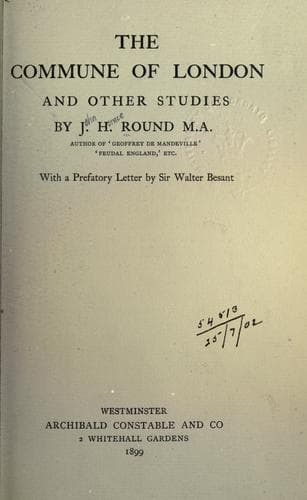
The Commune of London, and other studiesRound, John Horace
History
The Commune of London, and other studies
Round, John Horace
Great Britain -- History -- Norman period, 1066-1154; London (England) -- History -- To 1500
[69] See for the above quotations my ‘Feudal England,’ pp. 346, 354–6.
[70] William was familiar with this formation, for he makes, Mr.
Freeman wrote, Henry I. bid his English stand firm “in the array of the
ancient shield wall.”
[71] Feudal England, p. 354.
[72] Norman Conquest (2nd ed., iii. 764).
[73] Miss Norgate recognises this as “the English shield wall”
(‘England under the Angevin Kings,’ i. 292).
[74] Art of War, p. 26; History of the Art of War, p. 163.
[75] See, for these quotations, Freeman’s ‘Norman Conquest,’ iii. (2nd
ed.), 491 (where he quotes parallels from Dion Cassius and Ammianus),
and compare my ‘Feudal England,’ p. 358.
[76] History of the Art of War, p. 61.
[77] Ibid. p. 58.
[78] Ibid. p. 36.
[79] See above, p. 40.
[80] The italics are mine.
[81] The _spissa testudo_ of Florence is “of course” conveniently
ignored.
[82] “When the compact shield wall was broken, William thrust his
horsemen into the gaps” (p. 300). Just so.
[83] ‘Athenæum,’ 6th Aug., 1898. Mr. Oman had previously tried to
escape from his own words by pleading that “silence does not mean
a change of opinion” (‘Academy,’ 9th June, 1894). But I had been
careful to explain that I did not rely on his ‘silence,’ but on his
actually _substituting_ ‘shield wall’ for ‘palisades’ in the above
reproduced sentence (‘Academy,’ 19th May, 1894). Similarly, Mr. Oman,
as Col. Lloyd has observed (‘English Historical Review,’ x. 538),
“takes a different view” of the English formation at Crecy in the
latter of these two works from that which he had taken in the earlier,
substituting a wholly different arrangement of the archers.
[84] Mr. Freeman wrote of a “fortress of timber” with “wooden walls,”
composed of “firm barricades of ash and other timber” (see ‘Feudal
England,’ p. 340). Mr. George emphatically rejected this conception
(‘Battles of English History’).
[85] ‘Norman Conquest,’ iii. (2nd ed.), 476, faithfully reproducing
Henry of Huntingdon’s “dudum antequam coirent bellatores.”
[86] Guy of Amiens describes him as “Agmina præcedens innumerosa ducis.”
[87] Art of War, p. 25.
[88] Social England, p. 299.
[89] Academy, 9th June, 1894.
[90] History of the Art of War, p. 154.
[91] Mr. Oman, in his latest work, makes “brushwood” the material.
I had pointed out “the difficulty of hauling timber” under the
circumstances (‘Feudal England,’ p. 342).
[92] English Historical Review, ix. 18; cf. ix. 10.
[93] Ibid. ix. 232, 237–8.
[94] History of the Art of War, p. vi.
[95] English Historical Review, ix. 239.
[96] Ibid. p. 14.
[97] See Feudal England, pp. 354–8, 392.
[98] Die Schlacht von Hastings (Berlin), 1896.
[99] Athenæum, July 30, 1898.
Public-domain text, read in full here on John Shaqi.
Reviews
Reviews
No reviews yet
Be the first to share your thoughts on this work.
Elsewhere in the archive
Join the Discussion
Join the discussion
Sign in to leave a comment or review.
Sign InorCreate an account