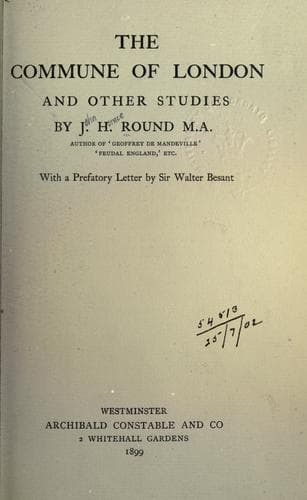
The Commune of London, and other studiesRound, John Horace
History
The Commune of London, and other studies
Round, John Horace
Great Britain -- History -- Norman period, 1066-1154; London (England) -- History -- To 1500
[353] Book of Howth (Carew Papers), p. 23. It would be of great
interest to the genealogical student to connect these Fitz Urses of
Ulster with the English family of the name, one of whom, Reginald, was
among the murderers of Becket (cf. ‘Geoffrey de Mandeville,’ p. 53).
Proof may be found, I think, among the charters of Stoke Curcy Priory,
Somerset, now at Eton (9th Report Hist. MSS., i. p. 353). The Fitz
Urses and De Curcis are found together among the Priory’s benefactors,
and William de Curci is the first witness to a charter of Reginald Fitz
Urse. We further find (Ibid.) a charter of William de Curci, to which
“John de Curci, Jordan de Curci” are witnessed. As the conqueror of
Ulster had a brother Jordan who was slain by the Irish, it is probable
that he may be found in this John de Curci, and his _provenance_
thus established. It is probable, therefore, that he was followed by
Fitz Urse to Ulster from Somerset, and possibly even by Russell (Ibid.
pp. 354 _a_, _b_).
[354] This was written some years ago.
[355] By the 22nd article of the Irish peace of January, 1648, the
natives were promised the repeal of two statutes, one against “the
ploughing with horses by the tail,” and the other prohibiting “the
burning of oats in the straw.”
[356] As this paper goes to press, the news arrives (3rd April, 1899)
of Mr. Davitt being stoned by his fellow-patriots at Swinford.
[357] Irish Ecclesiastical Record.
[358] See ‘Times,’ 8th Feb., 1886, p. 8.
[359] It has been so long spoken of as a “Bull” that one hardly knows
how to describe it. So long, however, as it is realized that it was
only a letter commendatory, no mistake can arise.
[360] Rolls Series, Edition v., 318.
[361] Ed. Hearne (1774), i. 42–48.
[362] Dublin Review, 3rd Ser., vol. 10, pp. 83–4.
[363] Ireland and St. Patrick, pp. 66, 68.
[364] Dublin Review, _ut supra_, pp. 93, 95.
[365] Ireland and St. Patrick (2nd Ed., 1892), pp. 65–147.
[366] Ibid. pp. 65, 85.
[367] Ibid. p. 143.
[368] Dublin Review, _ut supra_, p. 101.
[369] Ireland and St. Patrick, p. 128.
[370] Ibid. p. 121.
[371] Ireland and St. Patrick, pp. 128–9.
[372] The latest German papers appear to be those of Scheffer-Boichort
in ‘Mitteilungen des Instituts für Österreich-Geschichtsforschung,’
Erganzungsband iv. (1892); and of Pflugk-Harttung in ‘Deutsche
Zeitschrift für Geschichtswissenschaft,’ x. (1894).
[373] E. H. R., viii. pp. 18–52.
[374] Ibid. p. 42.
[375] “The majority of historians,” Miss Norgate writes (E. H. R.,
viii. 18), “have assumed that these two statements are two genuine and
independent accounts of one real transaction.” On this I pronounce,
for the present, no opinion; but I have printed the parallel passages
above, that readers may form their own opinion as to the points of
resemblance.
[376] It has, of course, been asserted to be an interpolation. But,
provisionally, I speak of it as his.
Public-domain text, read in full here on John Shaqi.
Reviews
Reviews
No reviews yet
Be the first to share your thoughts on this work.
Elsewhere in the archive
Join the Discussion
Join the discussion
Sign in to leave a comment or review.
Sign InorCreate an account