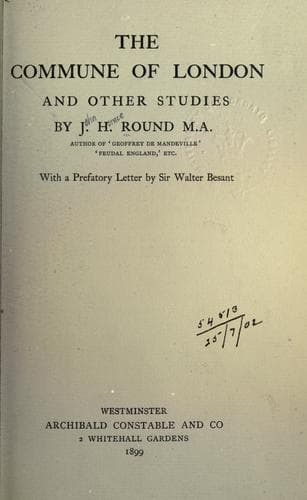
The Commune of London, and other studiesRound, John Horace
History
The Commune of London, and other studies
Round, John Horace
Great Britain -- History -- Norman period, 1066-1154; London (England) -- History -- To 1500
[377] Compare ‘England under the Angevin Kings,’ ii. 96 note, with E.
H. R., viii. 20. Miss Norgate might have learnt the fact from Cardinal
Moran’s paper, which was published 15 years before her work appeared.
[378] Vol. v. pp. 246–7.
[379] Ibid. pp. 318–9.
[380] Another quotation from Ovid occurs in the middle of this short
document.
[381] E. H. R., viii. 42.
[382] Ibid. p. 48.
[383] Ibid. p. 50.
[384] E. H. R., viii. 44.
[385] Ibid. p. 31.
[386] Dublin Review, _ut supra_, p. 90. So too on p. 96: “Giraldus
Cambrensis asserted that both these Bulls were produced in a synod of
Irish clergy at Waterford in A.D. 1175.” Cardinal Moran also
argued from this date.
[387] Ireland and St. Patrick, p. 131. He speaks, however, doubtless
by oversight, of “the confirmatory letter of Alexander III. himself in
1177” (p. 141), though it belongs to the same date.
[388] This is the erroneous form adopted by Professor Tout.
[389] Dictionary of National Biography, xix. 104.
[390] The words “per breve Ricardi de Luci” imply the king’s absence
from England, so that if William was despatched to Ireland in 1171, it
must have been before the king’s return on August 3. The charge would,
therefore, have appeared on the (Michaelmas) Pipe Roll.
[391] England under the Angevin Kings, ii. 115.
[392] Vol. v., p. lxxxiii.
[393] Close of 1171, or beginning of 1172.
[394] England under the Angevin Kings, ii. 116.
[395] “Hibernico populo tam dominandi quam ipsum in fidei rudimentis
incultissimum ecclesiasticis normis et disciplinis juxta Anglicanæ
ecclesiæ mores informandi” (v. 315).
[396] “It is quite certain that the Pope did, some time before
September 20, 1172, receive reports of Henry’s proceedings in Ireland,
both from Henry himself and from the Irish bishops, for he says so
in three letters--one addressed to Henry, another to the kings and
bishops of Ireland, and the third to the legate Christian bishop of
Lismore--all dated Tusculum, September 20.”
[397] E. H. R., viii. 44.
[398] Ibid. p. 50.
[399] The letter to Henry similarly speaks of “enormitates et vicia”
described in the prelates’ letters, and of “abominationis spurcitiam.”
[400] “Suis nobis literis intimarunt, et dilectus filius noster
R. Landavensis archidiaconus, vir prudens et discretus, et Regiæ
magnitudini vinculo præcipue devotionis astrictus, qui hoc oculata
fide perspexit viva nobis voce tam solicite quam prudenter exposuit”
... “eisdem Archiepiscopis et Episcopis significantibus, et præfato
Archidiacono plenius et expressius nobis referente, comperimus.”
[401] Gesta, i. 28; and Hoveden, ii. 31.
[402] Becket materials (Rolls, vii. 227, 233).
[403] The language must have been deliberately chosen, for the bishop’s
letters and the Pope’s action are described in the same words:
Public-domain text, read in full here on John Shaqi.
Reviews
Reviews
No reviews yet
Be the first to share your thoughts on this work.
Elsewhere in the archive
Join the Discussion
Join the discussion
Sign in to leave a comment or review.
Sign InorCreate an account