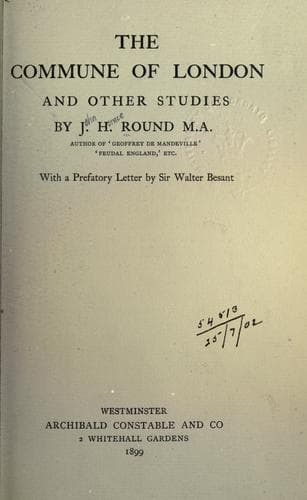
The Commune of London, and other studiesRound, John Horace
History
The Commune of London, and other studies
Round, John Horace
Great Britain -- History -- Norman period, 1066-1154; London (England) -- History -- To 1500
“confirmantes ei et heredibus “summus pontifex auctoritate
suis regnum Hiberniæ, et apostolica confirmavit ei et
testimonium perhibentes ipsos heredibus suis regnum illud,
eum et heredes suos sibi in et eos imperpetuum reges
reges et dominos constituisse constituit” (p. 28).
imperpetuum” (p. 26).
[404] “Et quia Romana ecclesia ... aliud jus habet in Insula quam
in terra magna et continua, nos ... magnificentiam tuam rogamus et
solicite commonemus ut in præscripta terra jura beati Petri nobis
studeas sollicite conservare,” etc., etc.
[405] E. H. R., viii. 45.
[406] Ibid. p. 50.
[407] In the text of ‘De principis instructione,’ as is pretty
generally known, the words “sicut a quibusdam asseritur aut
confingitur, ab aliis autem unquam impetratum fuisse negatur,” precede
this letter. They look, Mr. Dimock thought, like a marginal note which
has found its way into the text. I confess that to me also that is what
they suggest.
[408] According to Giraldus, the sole authority for its existence.
[409] The two letters hang together absolutely, it will be seen, in
every way.
[410] Dublin Review, _ut supra_, p. 90.
[411] E. H. R., viii. 48.
[412] E. H. R., viii. 23.
[413] Dublin Review, _ut supra_, pp. 97–103.
[414] Ibid., 3rd Series, vol. xi., pp. 328–339.
[415] E. H. R., viii. 34.
[416] _Vide supra_, p. 184.
[417] Gesta, i. 28.
[418] Irish Ecclesiastical Record, p. 61.
[419] Monumenta, p. 151.
[420] Rinuccini’s Embassy in Ireland (Hutton), pp. xxviii.-xxix. For
the essential passage the Italian runs: “stimando molto a proposito
il soggettare a se l’Isola d’Irlanda, ricorse ad Adriano, e da quel
pontefice, che Inglese era, ottene con mano liberale quanto bramava. Le
zelo che Arrigo dimostrò di voler convertire alla Fede tutta l’Irlanda,
piegò l’animo di Adriano a concedergli il dominio di essa” (Aiazzi’s
Nunziatura, p. xxxvi.).
[421] Const. Hist., i. 496.
[422] Norgate’s ‘England under the Angevin Kings,’ ii. 276.
[423] Gesta [Ed. Stubbs], ii. 80–83.
[424] Ed. Stubbs, iii. 9–12.
[425] Hoveden, iii. xiv. (1870).
[426] Ibid. iii. 9 note.
[427] Chron. Maj., ii. 348 note.
[428] Hist. Ang., iii. 209 note.
[429] Historia Anglorum, iii. 209.
[430] Chronica Majora, iii. 338 marginal note.
[431] Liber Rubeus, p. 759.
[432] See my paper, below, on “the Marshalship of England.”
[433] Red Book of the Exchequer, p. xviii. Compare my ‘Studies on the
Red Book of the Exchequer,’ p. 49.
[434] Rolls Series, ii. 339 note.
[435] Ibid. ‘Chronicles of the Reigns of Stephen,’ etc., iii. 408 note.
[436] Dictionary of National Biography.
[437] Ibid.
[438] Register of St. Osmund, i. 262; and Epistolæ Cantuarienses, p.
327.
[439] The date given by Dr. Stubbs.
[440] This from Hoveden.
Public-domain text, read in full here on John Shaqi.
Reviews
Reviews
No reviews yet
Be the first to share your thoughts on this work.
Elsewhere in the archive
Join the Discussion
Join the discussion
Sign in to leave a comment or review.
Sign InorCreate an account