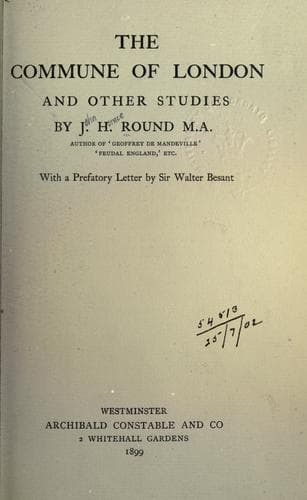
The Commune of London, and other studiesRound, John Horace
History
The Commune of London, and other studies
Round, John Horace
Great Britain -- History -- Norman period, 1066-1154; London (England) -- History -- To 1500
[441] So great, indeed, is the difficulty of forcing them into
accordance with Dr. Stubbs’ view, that he himself makes them all four
refer to a single surrender of Nottingham and Tickhill (Preface to
Rog. Hov. III. lvii., lviii.; cf. p. lxiii.), and assigns the Mortimer
incident to the earlier campaign, though it is described by Richard of
Devizes, who _ex hypothesi_ is narrating the later one.
[442] Gesta Regis Ricardi, ii. 208 note.
[443] Ed. Howlett, p. 337.
[444] It is a further illustration of the difficulty which even those
who accept Dr. Stubbs’ view find in adhering to it, that Miss Norgate
pronounces it “chronologically impossible” that the archbishop of
Rouen can have been sent to John by Longchamp, as stated by Richard of
Devizes (‘Angevin Kings,’ ii. 299 note). She must have forgotten that
Richard of Devizes _ex hypothesi_ is describing “events in the
summer or autumn” (Rog. Hov., iii. 134); and that she accepts April 27
as the date of the archbishop’s arrival (ii. 298).
[445] “Legationis suæ officium per mortem Romani pontificis exspirasse.”
[446] This suggestion is strongly supported by the fact, which has been
overlooked, that the bishop of Worcester was consecrated by Longchamp
“adhuc legato” on May 5 (Ric. Devizes, p. 403); that the chancellor
still styled himself legate on May 13 (‘Ancient Charters,’ p. 96); and
that he even used this style on July 8 at Lincoln (_vide infra_).
This implies, as I pointed out so far back as 1888 in my ‘Ancient
Charters’ (Pipe Roll Society), that he continued to use the style
after Clement’s death and before he could have known whether Cœlestine
would renew it to him or not. Indeed, if we may trust the version of
Giraldus, he was using it even so late as July 30 (iv. 389). It is
notable that in a communication dated “Teste meipso apud Releiam xxv
die Augusti,” he no longer employs it.
[447] England under the Angevin Kings, ii. 299.
[448] 9th Report Historical MSS., i. 35 _b_ (where the document is
dated “1190–1196”).
[449] 35th Report of Deputy Keeper, p. 2.
[450] This cannot be made public till my Calendar of Charters preserved
in France is issued. In it this evidence will be found in Document 61
(p. 17).
[451] The dating clause at its end is a blunder admitted on all sides.
[452] Preface to Rog. Hov., III. p. lxiv. This is, according to me, the
imaginary conference.
[453] Rog. Hov., iii. 135 note. So also ‘Gesta,’ ii. p. 208: “in which
John was recognised as the heir of England.”
[454] Pref. to Rog. Hov., III. lix.
[455] Ibid. p. lxiv.
[456] Gesta, ii. 207–8; Will. Newb., ii. 339.
[457] Roger Hov., iii. 135 note.
[458] Compare my ‘Geoffrey de Mandeville,’ pp. 176, 183, with Hoveden’s
text.
Public-domain text, read in full here on John Shaqi.
Reviews
Reviews
No reviews yet
Be the first to share your thoughts on this work.
Elsewhere in the archive
Join the Discussion
Join the discussion
Sign in to leave a comment or review.
Sign InorCreate an account