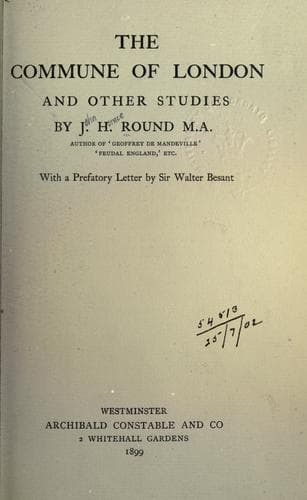
The Commune of London, and other studiesRound, John Horace
History
The Commune of London, and other studies
Round, John Horace
Great Britain -- History -- Norman period, 1066-1154; London (England) -- History -- To 1500
[459] “Resaisina vicecomitatus Lincolnie _fiet_ Girardo de
Camvilla: et eadem die dies ei conveniens _præfigetur_ standi in
curia domini regis ad judicium. Quod si contra eum monstrari poterit
quod judicio curiæ domini regis vicecomitatum vel castellum Lincolnie
perdere debuerit, perdat; sin minus retineat; nisi interim alio modo
pax inde fieri poterit.”
[460] “Girardo de Camvilla in gratiam cancellarii recepto, remansit
illi in bono et pace custodia castri de Lincolnia.”
[461] Compare Rog. Hov., III. lxiv., _ut supra_, and the ‘Histoire
de Guillaume le Maréchal,’ ll. 11,888–11,882:
“Je entent e vei
Que par dreit, si’n sui aseiir,
Le [rei] devom nos faire de Artur.”
[462] Compare my article on “Historical Research” in ‘Nineteenth
Century,’ December, 1898.
[463] Archæological Journal, L. 247–263.
[464] Const. Hist., iii. 568.
[465] Mr. Loftie writes, in his ‘London,’ that “in the reign of Henry
I. we find the guild in full possession of the governing rights which
are elsewhere attributed to a guild merchant” (p. 30). See also p. 103
above.
In the same series, Dean Kitchin applies this assumption to Winchester,
and observes of the “Knights,” who possessed a ‘hall’ there under
Henry I., that “if we may argue from the parallel of the London
Knights’ Guild, the body had the charge of the city, and was in fact
the original civic corporation of Winchester,” (‘Historic Towns:
Winchester,’ p. 74).
[466] See ‘Geoffrey de Mandeville.’
[467] “Nunc primum in sibi indulta conjuratione regno regem deesse
cognovit Londonia, quam nec rex ipse Ricardus, nec prædecessor et
p. ter ejus Henricus pro mille millibus marcarum argenti fieri
permisisset” (Richard of Devizes, p. 416).
[468] “Facta conjuratione adversus eam quam cum honore susceperunt cum
dedecore apprehendere statuerunt” (See ‘Geoffrey de Mandeville,’ p.
115).
[469] See note above.
[470] Const. Hist., i. 407.
[471] “Facta conspiratione quam communionem vocabant sese omnes pariter
sacramentis adstringunt et ... ejusdem regionis proceres, quamvis
invitos, sacramentis suae conspirationis obligari compellunt.”
[472] See my paper in ‘Academy’ of 12th November, 1887.
[473] Transactions of the London and Middlesex Arch. Soc., v. 286.
[474] Ibid. p. 286–7.
[475] Mr. Loftie’s argument (‘London,’ p. 53) that Glanville’s words
prove that London, if not other towns as well, had already a ‘Commune’
under Henry II. is disposed of by Dr. Gross (‘The Gild Merchant,’ i.
102).
[476] £125 and £5 10_s._ respectively for a quarter in 19 Hen. II.
p. 183, and £375 and £16 10_s._ respectively for three-quarters in
20 Hen. II. (p 7).
[477] ‘Geoffrey de Mandeville,’ p. 297.
[478] 20 Hen. II., p. 9. The official list (Deputy Keeper’s 31st
Report) omits to mention that they answered “ut custodes” for this
quarter.
[479] ‘Geoffrey de Mandeville,’ pp. 297–8.
[480] On the _firma burgi_ see Stubbs, ‘Const. Hist.’ (1874), p.
410; and Maitland, ‘Domesday Book and Beyond,’ pp. 204–5.
Public-domain text, read in full here on John Shaqi.
Reviews
Reviews
No reviews yet
Be the first to share your thoughts on this work.
Elsewhere in the archive
Join the Discussion
Join the discussion
Sign in to leave a comment or review.
Sign InorCreate an account