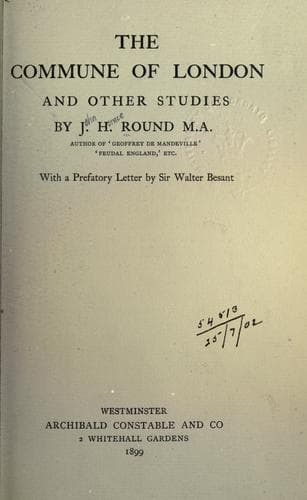
The Commune of London, and other studiesRound, John Horace
History
The Commune of London, and other studies
Round, John Horace
Great Britain -- History -- Norman period, 1066-1154; London (England) -- History -- To 1500
[481] Compare the ‘Dialogus’: “De summa vero summarum quæ ex omnibus
fundis surgebat in uno comitatu constituerunt vicecomitem illius
comitatus ad scaccarium teneri” (i. 4).
[482] Op. cit. _ut supra_.
[483] 21 Henry II., pp. 15–17. For the last quarter of the 20th year
they were £59 8_s._ 2_d._
[484] From the county the proceeds must always have been small owing to
the absence of royal manors.
[485] Pipe Rolls, _passim_.
[486] They had paid out £156 7_s._ 4_d._ in the three quarters, and
owed £9 9_s._ 9_d._, making a total of £165 17_s._ 1_d._, or at the
rate of about £221 a year, as against some £238.
[487] His outgoings were £151 4_s._ 6_d._, and he was credited with a
“superplus” of £13 8_s._ 10_d._ ‘blank.’ This works out at rather over
£548 “numero” for the year, the old figure being £547 “numero” (these
figures are taken from the unpublished Pipe Roll of 1176). It would
be rash to connect the change with the severe Assise of Northampton
without further evidence.
[488] An entry on the Roll of 15 Hen. II. records it as £500 “blanch,”
plus a varying sum of about £20 “numero.”
[489] Add. MS. 14,252, fo. 112 _d_.
[490] MS.: ‘skiuin.’ The ‘Liber Albus’ (pp. 423–4) uses “eskevyn” for
the _échevins_ of Amiens.
[491] _i.e._ Queen Eleanor.
[492] Walter archbishop of Rouen.
[493] “For their administration and judicial functions in continental
towns, see Giry, ‘St. Quentin,’ 28–67; von Maurer, ‘Stadtverf.,’ i.
241, 568” (‘Gild Merchant,’ i. 26 note).
[494] Add. MS. 14,252, fo. 110.
[495] Liber de Antiquis Legibus (Camden Soc.), p. 2.
[496] London and the Kingdom (1894), i. 72.
[497] London (1887), p. 45.
[498] History of London, i. 190.
[499] Liber Albus, i. 41.
[500] “Quicumque predictorum, sine licentia majoris abierit de
congregacione aliorum, tantundem paccabit,” etc. (‘Établissements,’ §
4).
[501] “Si quid major celari preceperit, celabunt. Hoc quicunque
detexerit, a suo officio deponetur,” etc. (‘Établissements,’ § 2).
[502] See Liber Albus, i. 307–8.
[503] Compare the case quoted in Palgrave’s ‘Commonwealth,’ II. p.
clxxxiii.
[504] Arch. Journ., ix. 70.
[505] Ibid. p. 81.
[506] Historic Towns: Winchester, p. 166.
[507] In his valuable ‘Étude sur les origines de la commune de St.
Quentin,’ M. Giry has shown that this early example, with those derived
from it, was distinguished by the separate existence and status of the
_échevins_. Nor have the _Établissements_ as much in common
with the London _commune_ as those of Rouen.
[508] Archæological Journal, L. 256–260.
[509] Feudal England, 552 _et seq._
[510] Norgate’s ‘England under the Angevin Kings,’ i. 48–9.
[511] These passages are quoted to show that the influence of Rouen on
London is admitted by an independent writer.
[512] ‘Les Établissements de Rouen’ (Bibliothèque de l’école des
hautes études, publiée sous les auspices du Ministère de l’instruction
publique, 1883).
[513] He became, in that year, bishop of Lisieux.
Public-domain text, read in full here on John Shaqi.
Reviews
Reviews
No reviews yet
Be the first to share your thoughts on this work.
Elsewhere in the archive
Join the Discussion
Join the discussion
Sign in to leave a comment or review.
Sign InorCreate an account