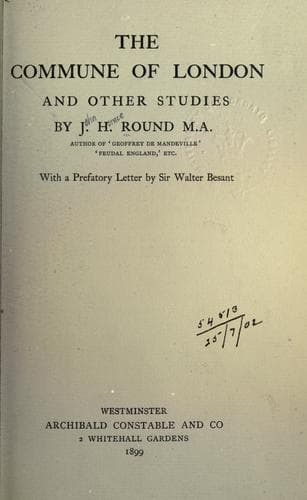
The Commune of London, and other studiesRound, John Horace
History
The Commune of London, and other studies
Round, John Horace
Great Britain -- History -- Norman period, 1066-1154; London (England) -- History -- To 1500
[514] I am in a position to date this charter precisely as at or about
Feb., 1175.
[515] Recurring, in his “Conclusions” at the end of the volume, to
this question of date, M. Giry seems to combine two of his different
limits: “L’étude du texte nous a permis de fixer la rédaction des
Établissements aux dernières années du règne de Henri II., après 1169.
Nous savons, de plus que La Rochelle les avait adoptés avant 1199, que
Rouen les avait également possédés vers la même époque, entre 1177 et
1183” (p. 427). Of these dates, I can only repeat that “1183” has its
origin in an error; “1177” is, I think, a mistake, and “1169” difficult
to understand. My forthcoming calendar of charters in France will throw
fresh light upon the date.
[516] Ancient Deeds, A. 1477.
[517] Sheriff of London 1174–6. Also Alderman (Palgrave, II. clxxxiii.).
[518] Cot. MS. Faust, B. ii., fo. 66 _d_.
[519] Add. MS. 14,252, fo. 106.
[520] “Major debet custodire claves civitatis et cum assensu parium
talibus hominibus tradere in quibus salve sint.
“Si aliquis se absentaverit de excubia ipse erit in misericordia
majoris secundum quod tunc fuerit magna necessitas excubandi”
(‘Établissements de Rouen,’ ii. 44).
[521] Add. MS. 14,252, fo. 106.
[522] MS. ‘escauingores.’
[523]? consilio.
[524] Add. MS. 14,252, fo. 126.
[525] The ‘th’ in the first ‘Spelethorn’ is an Anglo-Saxon character.
[526] This is the “Terra Roberti Fafiton” (at Stepney) of Domesday, i.
130.
[527] Cf. Domesday, i. 128.
[528] Rectius “Hendune.”
[529] From Domesday Book.
[530] This may be chiefly due to omitting “Mimms” (70 hides) and
reckoning Ossulston at 20 hides too much.
[531] The Red Book of the Exchequer (Rolls Series), pp. 469–574.
[532] Mr. Hall has since, in the ‘Athenæum’ (10th Sept., 1898),
repeated the view that the ‘Red Book’ returns were “made in the two
preceding years.”
[533] It will be found on p. 296 of the printed text.
[534] “Idem rex præcepit omnibus vicecomitibus ut confiscarentur
redditus et omnia beneficia clericorum data eis a Stephano
archiepiscopo et ab episcopis Angliæ moram facientibus in transmarinis
post interdictum Anglicanæ ecclesiæ, in hæc verba:
“‘Præcipimus vobis quod capiatis ... et scire faciatis distincte
in crastino Sancti Johannis Baptistæ anno regni nostri xiv
baronibus nostris de scaccario ubi fuerint redditus illi et
quantum singuli valeant et qui illi sunt qui eos receperunt.
Datum vii id. Junii’” (p. 267).
It is noteworthy that the returns to both writs were to be due on the
same day (June 25), which accounts for their commixture in the ‘Testa.’
The remarkable rapidity with which such returns could be made to a
royal writ should be carefully observed.
[535] “Per veredictum” (printed in ‘Testa’ “per unum dictum”).
[536] Testa de Nevill, pp. 401–408.
[537] This corrupt list in the ‘Liber Rubeus’ is evidently akin to
a similarly corrupt one interpolated in the ‘Testa’ (p. 408), as is
proved by this name.
Public-domain text, read in full here on John Shaqi.
Reviews
Reviews
No reviews yet
Be the first to share your thoughts on this work.
Elsewhere in the archive
Join the Discussion
Join the discussion
Sign in to leave a comment or review.
Sign InorCreate an account