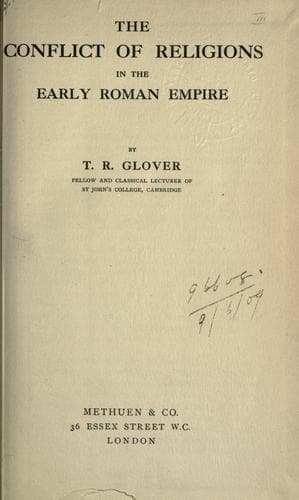
The Conflict of Religions in the Early Roman EmpireGlover, T. R. (Terrot Reaveley)
Religion
The Conflict of Religions in the Early Roman Empire
Glover, T. R. (Terrot Reaveley)
Christianity and other religions; Church history -- Primitive and early church, ca. 30-600; Rome -- Religion
What then is to be said of Plutarch's religion? Here his experience
was not so readily intelligible, and every inherited and acquired
instinct within him conspired to make him cling to tradition and
authority as opposed to independent judgment. His philosophy was not
Plato's, in spite of much that he borrowed from Plato, for its motive
was not the love of truth. The stress he lays upon the pleasure of
believing shows that his ultimate canon is emotion. He does not really
wish to find truth on its own account, though he honestly would like
its support. He wishes to believe, and believe he will--_sit pro
ratione voluntas_. "There is something of the woman in Plutarch," says
Mr Lecky. Like men of this temperament in every age, he surrenders to
emotion, and emotion declines into sentimentalism. He cannot firmly
say that anything, with which religious feeling has ever been
associated, has ceased to be useful and has become false. He may talk
bravely of shutting the great door against Superstition, but
Superstition has many entrances--indeed, was indoors already.
We have only to look at his treatise on Isis and Osiris to see the
effects of compromise in religion. He will never take a firm stand;
there are always possibilities, explanations, parallels, suggestions,
symbolisms, by which he can escape from facing {111} definitely the
demand for a decisive reformation of religion. As a result, in spite
of the radiant mist of amiability, which he diffuses over these
Egyptian gods, till the old myths seem capable of every conceivable
interpretation, and everything a symbol of everything else, and all is
beautiful and holy--the foolish and indecent old stories remain a
definite and integral part of the religion, the animals are still
objects of worship and the image of Osiris stands in its original naked
obscenity.[130] And the Egyptian is not the only religion, for, as
Tertullian points out, the old rites are still practised every where!"
with unabated horrors, symbol or no symbol.[131] Plutarch emphasizes
the goodness and friendliness of the gods, but he leaves the evil
daemons in all their activity. Strange and awful sacrifices of the past
he deprecates, but he shows no reason why they should not continue.
God, he says, is hardly to be conceived by man's mind as in a dream;
and he thanks heaven for its peculiar grace that the oracles are
reviving in his day; he believes in necromancy, theolepsy and nearly
every other grotesque means of intercourse with gods and daemons. He
calls himself a Platonist; he is proud of the great literature of
Greece; but nearly all that we associate in religious thought with such
names as Xenophanes, Euripides and Plato, he gently waves aside on the
authority of Apollo. It raises the dignity of Seneca when we set
beside him this delightful man of letters, so full of charm, so warm
with the love of all that is beautiful, so closely knit to the tender
Public-domain text, read in full here on John Shaqi.
Reviews
Reviews
No reviews yet
Be the first to share your thoughts on this work.
Elsewhere in the archive
Join the Discussion
Join the discussion
Sign in to leave a comment or review.
Sign InorCreate an account