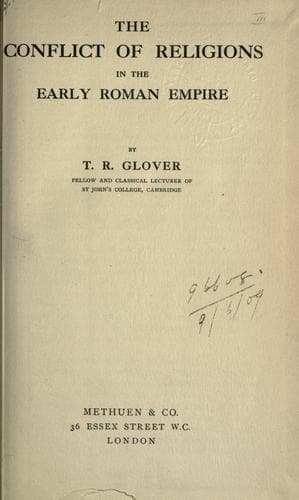
The Conflict of Religions in the Early Roman EmpireGlover, T. R. (Terrot Reaveley)
Religion
The Conflict of Religions in the Early Roman Empire
Glover, T. R. (Terrot Reaveley)
Christianity and other religions; Church history -- Primitive and early church, ca. 30-600; Rome -- Religion
An amiable feeling for Nature is often to be found in sentimental
characters. But sentimentalism is essentially self-deception; and the
Gospels make it clear that of all human sins and weaknesses none seems
to have stirred the anger of Jesus as did self-deception. When the
Pharisees in the synagogue watched to see whether Jesus would heal on
the Sabbath, he "looked round about upon them all with anger," says
Mark. This gaze of Jesus is often mentioned in the Gospels--almost
unconsciously--but Luke and Matthew drop the last two words in quoting
this passage, and do so at the cost {124} of a most characteristic
touch. Matthew elsewhere, in accordance with his habit of grouping his
matter by subject, gathers together a collection of the utterances of
Jesus upon the Pharisees, with the recurring refrain "Scribes and
Pharisees, actors." The Mediterranean world was full of Greek actors;
we hear of them even among the Parthians in 53 B.C., and in Mesopotamia
for centuries; and as there had long been Greek cities in Palestine,
and a strong movement for generations toward Greek ways of life, the
actor cannot have been an unfamiliar figure. To call the Pharisees
"actors" was a new and strong thing to say, but Jesus said such things.
Of the grosser classes of sinners he was tolerant to a point that
amazed his contemporaries and gave great occasion of criticism to such
enemies as Celsus and Julian. He had apparently no anger for the woman
taken in adultery; and he was the "friend of publicans and
sinners"--even eating with them.
[Sidenote: His sense of the real]
The explanation lies partly in Jesus' instinct for reality and truth.
Sensualist and money-lover were at least occupied with a sort of
reality; pleasure and money in their way are real, and the pursuit of
them brings a man, sooner or later, into contact with realities genuine
enough. Whatever illusions publican and harlot might have, the world
saw to it that they did not keep them long. The danger for such people
was that they might be disillusioned overmuch. But the Pharisee lied
with himself. If at times he traded on his righteousness to over-reach
others, his chief victim was himself, as Jesus saw, and as Paul found.
Paul, brought up in their school to practise righteousness, gave the
whole thing up as a pretence and a lie--he would no longer have
anything to do with "his own righteousness." But he was an exception;
Pharisees in general believed in their own righteousness; and, by
tampering with their sense of the proportions of things, they lost all
feeling for reality, and with it all consciousness of the value and
dignity of man and the very possibility of any conception of God.
Public-domain text, read in full here on John Shaqi.
Reviews
Reviews
No reviews yet
Be the first to share your thoughts on this work.
Elsewhere in the archive
Join the Discussion
Join the discussion
Sign in to leave a comment or review.
Sign InorCreate an account