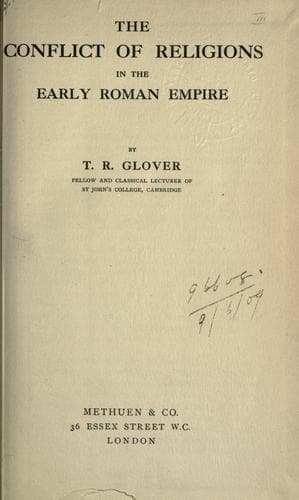
The Conflict of Religions in the Early Roman EmpireGlover, T. R. (Terrot Reaveley)
Religion
The Conflict of Religions in the Early Roman Empire
Glover, T. R. (Terrot Reaveley)
Christianity and other religions; Church history -- Primitive and early church, ca. 30-600; Rome -- Religion
It is clear, however, that, outside Palestine, the Jews in the great
world were moving to a more purely moral conception of religion--their
environment made mere Pharisaism impossible, and Greek criticism
compelled them to think more or less in the terms of the fundamental.
The debt of the Jew to the Gentile is not very generously acknowledged.
None the less, the distinctive badge of all his tribe was and remained
what the Greeks called fussiness (_to psophodees_).[20] The Sabbath,
circumcision, the blood and butter taboos remained--as they still
remain in the most liberal of "Liberal Judaisms"--tribe marks with no
religious value, but maintained by patriotism. And side by side with
this lived and lives that hatred of the Gentile, which is attributed to
Christian persecution, but which Juvenal saw and noted before the
Christian had ceased to be persecuted by the Jew. The extravagant
nonsense found in Jewish speculation as to how many Gentile souls were
equivalent in God's sight to that of one Jew is symptomatic. To this
day it is confessedly the weakness of Judaism that it offers no impulse
and knows no enthusiasm for self-sacrificing love where the interests
of the tribe are not concerned.[21]
The great work of Jesus in this matter was the final and decisive
cleavage with antiquity. Greek rationalism had long since laughed at
the puerilities of the Greek cults; but rationalism and laughter are'
unequally matched against Religion, and it triumphed over them, and, as
we see in Plutarch {133} and the Neo-Platonists, it imposed its
puerilities--yes, and its obscenities--upon Philosophy and made her in
sober truth "procuress to the lords of hell." It was a new thing when
Religion, in the name of truth and for the love of God, abolished the
connexion with a trivial past. Jesus cut away at once every vestige of
the primitive and every savage survival--all natural growths perhaps,
and helpful too to primitive man and to the savage, but confusing to
men on a higher plane,--either mere play-acting or the "damnation of
hell." Pagan cults he summed up as much speaking. Once for all he set
Religion free from all taboos and rituals. Paul, once, on the spur of
the moment, called Jesus the "Yes" of all the promises of God--a most
suggestive name for the vindicator and exponent of God's realities. It
is such a man as this who liberates mankind, cutting us clear of
make-believes and negations and taboos, and living in the open-air,
whether it is cloud or sun. That Jesus shocked his contemporaries with
the abrupt nakedness of his religious ideas is not surprising. The
church made decent haste to cover a good many of them up, but not very
successfully. A mind like that of Jesus propagates itself, and
reappears with startling vitality, as history in many a strange page
can reveal.
Public-domain text, read in full here on John Shaqi.
Reviews
Reviews
No reviews yet
Be the first to share your thoughts on this work.
Elsewhere in the archive
Join the Discussion
Join the discussion
Sign in to leave a comment or review.
Sign InorCreate an account