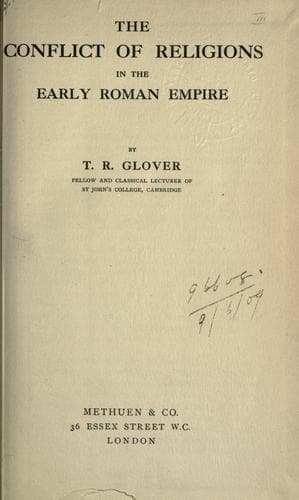
The Conflict of Religions in the Early Roman EmpireGlover, T. R. (Terrot Reaveley)
Religion
The Conflict of Religions in the Early Roman Empire
Glover, T. R. (Terrot Reaveley)
Christianity and other religions; Church history -- Primitive and early church, ca. 30-600; Rome -- Religion
We must now consider what was the thought of Jesus upon God and how he
conceived of the relation between God and man. He approached the
matter originally from the standpoint of Judaism, and no attempt to
prove the influence of Greek philosophy is likely to succeed. The
result of Greek speculation upon God--where it did not end in pure
pantheism--was that of God nothing whatever could be predicated--not
even being, but that he was to be expressed by the negation of every
idea that could be formed of him. To this men had been led by their
preconception of absolute being, and so strong was the influence of
contemporary philosophy that Christian thinkers adopted the same
conclusion, managing what clumsy combinations they could of it and of
the doctrine of incarnation. Clement of Alexandria is a marked example
of this method.
To the philosophic mind God remains a difficult problem, but to the
religious temper things are very different. To it God is the one great
reality never very far away, and is conceived not as an abstraction,
nor as a force, but as a personality. {134} It has been and is the
strength and redemption of Judaism, that God is the God of Israel--"Oh
God, thou art my God!" How intuition is to be reconciled with
philosophy has been the problem of Christian thinkers in every age, but
it may be remarked that the varying term is philosophy. To the
intuition of Jesus Christians have held fast--though Greeks and others
have called it "folly"; and in the meantime a good many philosophies
have had their day.
The central thought of Jesus is the Fatherhood of God. For this, as
for much else, parallels have been found in the words of Hebrew
thinkers, ancient and contemporary, and we may readily concede that it
was not original with Jesus to call God Father. The name was given to
God by the prophets, but it was also given to him by the Stoics--and by
Homer; so that to speak of God's Fatherhood might mean anything between
the two extremes of everything and nothing. Christian theology, for
instance, starting with the idea of the Fatherhood of God, has not
hesitated to speak in the same breath of his "vindicating his
majesty"--a phrase which there is no record or suggestion that Jesus
ever used. There may be fathers who vindicate their majesty, as there
are many other kinds, but until we realize the connotation of the word
for men who speak of God as Father, it is idle to speak of it being a
thought common to them. The name may be in the Old Testament and in
Homer, but the meaning which Jesus gave to it is his own.
Public-domain text, read in full here on John Shaqi.
Reviews
Reviews
No reviews yet
Be the first to share your thoughts on this work.
Elsewhere in the archive
Join the Discussion
Join the discussion
Sign in to leave a comment or review.
Sign InorCreate an account