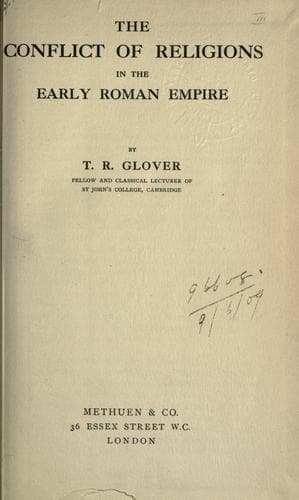
The Conflict of Religions in the Early Roman EmpireGlover, T. R. (Terrot Reaveley)
Religion
The Conflict of Religions in the Early Roman Empire
Glover, T. R. (Terrot Reaveley)
Christianity and other religions; Church history -- Primitive and early church, ca. 30-600; Rome -- Religion
Jesus never uses the name Father without an air of gladness. Men are
anxious as to what they shall eat, and what they shall drink, and
wherewithal they shall be clothed--"your heavenly Father knoweth that
ye have need of all these things." Children ask father and mother for
bread--will they receive a stone? The women had hid the leaven in the
three measures of meal long before the children began to feel hungry.
And as to clothes--God has clothed the flower far better than Solomon
ever clothed himself, "and shall he not much more clothe you, O ye of
little faith?" The picture is one of the strong and tender parent,
smiling at the child's anxiety with no notion of his own majesty or of
anything but love. So incredibly simple is the relation between God
and man--simple, unconstrained, heedless and tender as the talk round a
table in Nazareth. Jesus is greater than the men who have elaborated
{135} his ideas, and majesty is the foible of little minds. The great
man, if he thinks of his dignity, lets it take care of itself; he is
more interested in love and truth, and he forgets to think of what is
due to himself. Aristotle said that his "magnificent man" would never
run; but, says Jesus, when the prodigal son was yet a great way off,
"his father saw him, and ran, and fell on his neck, and kissed him."
This contrast measures the distance between the thought of Jesus and
some Christian theologies. It is worth noting that in the two
parables, in which a father directly addresses his son, it is with the
tender word _teknon_, which is more like a pet name. It adds to the
meaning of the parable of the prodigal, when the father calls the elder
brother by the little name that has come down from childhood. It was a
word which Jesus himself used in speaking to his friends.[22] The
heavenly Father does not cease to be a father because his children are
ungracious and bad. He sends rain and sun--and all they mean--to evil
and to good. The whole New Testament is tuned to the thought of
Jesus--"the philanthropy of God our saviour."[23]
Public-domain text, read in full here on John Shaqi.
Reviews
Reviews
No reviews yet
Be the first to share your thoughts on this work.
Elsewhere in the archive
Join the Discussion
Join the discussion
Sign in to leave a comment or review.
Sign InorCreate an account