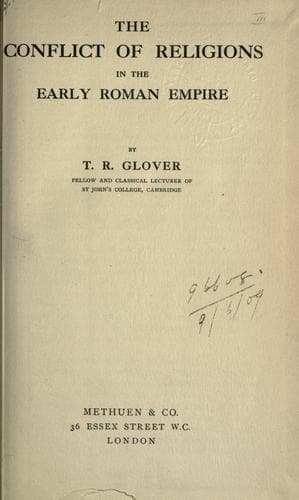
The Conflict of Religions in the Early Roman EmpireGlover, T. R. (Terrot Reaveley)
Religion
The Conflict of Religions in the Early Roman Empire
Glover, T. R. (Terrot Reaveley)
Christianity and other religions; Church history -- Primitive and early church, ca. 30-600; Rome -- Religion
The Christians, finding ecstasy, prophecy, trance, and glossolaly among
their own members, and having before them the parallel of Greek
priestesses and Hebrew prophets, and making moreover the same _very_
slight distinction as their pagan {154} neighbours between matter and
spirit, and, finally, possessing all the readiness of unscientific
people in propounding theories,--they assumed an "effluence" from God,
a spirit which entered into a man, just as in ordinary life evil demons
did, but here it was a holy spirit. This they connected with God after
the manner familiar to Jewish thinkers, and following the same lead,
began to equate it with God, as a separate being. It is not at first
always quite clear whether it is the spirit of God or of Jesus--or even
a manifestation of the risen Jesus.[44]
When we pass to the early explanations of Jesus, we come into a region
peculiarly difficult. A later age obscured the divergences of early
theory. Some opinions the church decisively rejected--Christians would
have nothing to do with a Jesus who was an emanation from an absolute
and inconceivable Being, a Jesus who in that case would be virtually
indistinguishable from Asclepios the kindly-natured divine healer. Nor
would they tolerate the notion of a phantom-Jesus crucified in show,
while the divine Christ was far away--like Helen in Euripides'
play.[45] "Spare," says Tertullian, "the one hope of all the
world."[46] They would not have a "daimonion without a body." But two
theories, one of older Jewish, and the other of more recent Alexandrian
origin, the church accepted and blended, though they do not necessarily
belong to each other.
[Sidenote: Paul]
The one theory is especially Paul's--sacred to all who lean with him to
the Hebrew view of things, to all who, like him, are touched with the
sense of sin and feel the need of another's righteousness, to all who
have come under the spell of the one great writer of the first century.
A Jew, a native of a Hellenistic city--and "no mean one"[47]--a citizen
of the Roman Empire, a man of wide outlooks, with a gift for
experience, he passed from {155} Pharisaism to Christ. The mediating
idea was righteousness. He knew his own guilt before God, and found
that by going about to establish his own righteousness he was achieving
nothing.
Public-domain text, read in full here on John Shaqi.
Reviews
Reviews
No reviews yet
Be the first to share your thoughts on this work.
Elsewhere in the archive
Join the Discussion
Join the discussion
Sign in to leave a comment or review.
Sign InorCreate an account