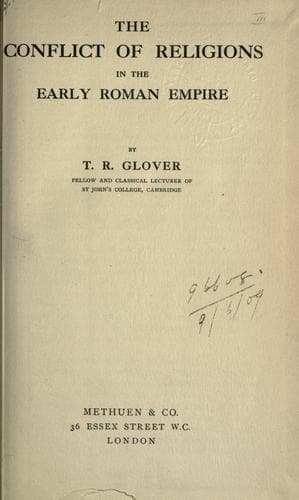
The Conflict of Religions in the Early Roman EmpireGlover, T. R. (Terrot Reaveley)
Religion
The Conflict of Religions in the Early Roman Empire
Glover, T. R. (Terrot Reaveley)
Christianity and other religions; Church history -- Primitive and early church, ca. 30-600; Rome -- Religion
At the same time a suffering Messiah was a contradiction in terms,
unspeakably repulsive to a Jew. We can see this much in the tremendous
efforts of the Apologists to overcome Jewish aversion by producing Old
Testament prophecies that Christ was to suffer. _Pathetos_ (subject to
suffering) was a word that waked rage and contempt in every one, who
held to contemporary views of God, or even had dabbled in Stoic or
similar conceptions of human greatness. But it seems that the serenity
and good conscience of Christian martyrs impressed their persecutor,
who was not happy in his own conscience; and at last the thought
came--along familiar lines--that Christ's sufferings might be for the
benefit of others. And then he saw Jesus on the road to Damascus.
What exactly happened is a matter of discussion, but Paul was
satisfied--he was "a man in Christ."
Much might be said in criticism of Paul's Christology--if it were not
for Paul and his followers. They have done too much and been too much
for it to be possible to dissect their great conception in cold blood.
Paul's theories are truer than another man's experiences--they pulse
with life, they have (in Luther's phrase) hands and feet to carry a man
away. The man is so large and so strong, so simple and true, so
various in his knowledge of the world, so tender in his feeling for
men--"all things to all men"--such a master of language, so sympathetic
and so open--he is irresistible. The quick movement of his thought,
his sudden flashes of anger and of tenderness, his apostrophes, his
ejaculations--one feels that pen and paper never got such a man written
down before or since. Every sentence comes charged with the whole
man--half a dozen Greek words, and not always the best Greek--and the
Christian world for ever will sum up its deepest experience in "God
forbid that I should glory save in the cross of our Lord Jesus Christ,
by whom the world is crucified unto me and I unto the world."
Close examination reveals a good deal of Judaism surviving in Paul,--a
curious way of playing with the text of Scripture, {156} odd
reminiscences of old methods, and deeper infiltrations of a Jewish
thought which is not that of Jesus. Yet it does not affect our feeling
for him--he stands too close to us as a man, too much over us as the
teacher of Augustine, Calvin and Luther--a man, whom it took more
genius to explain than the church had for fifteen centuries, and yet
the man to whom the church owes its universal reach and unity, its
theology and the best of the language in which it has expressed its
love for his master.
[Sidenote: Explanation of Jesus]
Public-domain text, read in full here on John Shaqi.
Reviews
Reviews
No reviews yet
Be the first to share your thoughts on this work.
Elsewhere in the archive
Join the Discussion
Join the discussion
Sign in to leave a comment or review.
Sign InorCreate an account