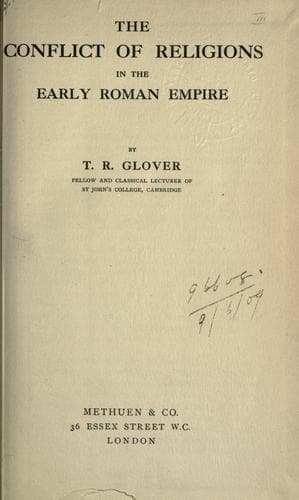
The Conflict of Religions in the Early Roman EmpireGlover, T. R. (Terrot Reaveley)
Religion
The Conflict of Religions in the Early Roman Empire
Glover, T. R. (Terrot Reaveley)
Christianity and other religions; Church history -- Primitive and early church, ca. 30-600; Rome -- Religion
The Christian came to the helpless and hopeless, whom men despised, and
of whom men despaired, with a message of the love and tenderness of
God, and he brought it home by a new type of love and tenderness of his
own. Kindness to friends the world knew; gentleness, too, for the sake
of philosophic calm; clemency and other more or less self-contained
virtues. The "third race" had other ideas--in all their virtues there
was the note of "going out of oneself," the unconsciousness which Jesus
loved--an instinctive habit of negating self (_aparnesasthai heauton_),
which does not mean medieval asceticism, nor the dingy modern virtue of
self-denial. There was no sentimentalism in it; it was the spirit of
Jesus spiritualizing and transforming and extending the natural
instinct of brotherliness by making it theocentric. Christians for a
century or two never thought of _ataraxia_ or apathy, and, though
Clement of Alexandria plays with them, he tries to give them a new
turn. Fortunately the Gospels were more read than the _Stromateis_ and
"Christian apathy" never succeeded. The heathen recognized sympathy as
a Christian characteristic--"How these {162} Christians love each
other!" they said. Lucian bears the same testimony to the mutual care
and helpfulness of Christians. "You see," wrote Lucian, "these poor
creatures have persuaded themselves that they are immortal for all time
and will live for ever, which explains why they despise death and
voluntarily give themselves up, as a general rule; and then their
original law-giver persuaded them that they are all brothers, from the
moment that they cross over and deny the gods of Greece and worship
their sophist who was gibbeted, and live after his laws. All this they
accept, with the result that they despise all worldly goods alike and
count them common property." In a later century Julian, perhaps
following Maximin Daza, whom he copied in trying to organize heathenism
into a new catholic church, urged benevolence on his fellow-pagans, if
they wished to compete with the Christians. It was the only thing, he
felt, that could revive paganism, and his appeal met with no response.
"Infinite love in ordinary intercourse" is the Christian life, and it
must come from within or nowhere. No organization can produce it, and,
however much we may have to discount Christian charity in some
directions as sometimes mechanical, the new spirit of brotherhood in
the world presupposed a great change in the hearts of men.
Public-domain text, read in full here on John Shaqi.
Reviews
Reviews
No reviews yet
Be the first to share your thoughts on this work.
Elsewhere in the archive
Join the Discussion
Join the discussion
Sign in to leave a comment or review.
Sign InorCreate an account