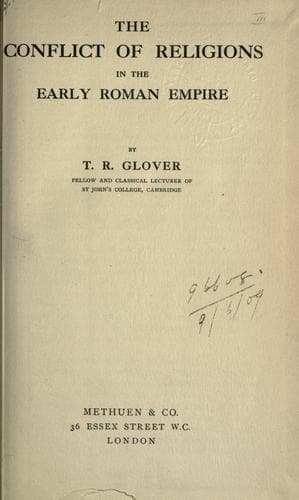
The Conflict of Religions in the Early Roman EmpireGlover, T. R. (Terrot Reaveley)
Religion
The Conflict of Religions in the Early Roman Empire
Glover, T. R. (Terrot Reaveley)
Christianity and other religions; Church history -- Primitive and early church, ca. 30-600; Rome -- Religion
It is a much discussed question as to how far Jesus realized the
profound gulf between his own religious position and that of his
contemporaries. Probably, since tradition meant more to them, they
were quicker to see declension from orthodox Judaism than a mind more
open and experimental; and when they contrived his death, it was with a
clear sense of acting in defence of God's Law and God's Covenant with
Israel. From their own point of view they were right, for the triumph
of the ideas of Jesus was the abolition of tribal religions and their
supersession by a new mind or spirit with nothing local or racial about
it.
The death of Jesus meant to the little community, which he left behind
him, a final cleavage with the system of their fathers, under which
they had been born, and with which was associated every religious idea
they had known before their great intimacy began. It was a moment of
boundless import in the history of mankind. Slowly and reluctantly
they moved out into the great unknown,--pilgrim fathers, unconscious of
the great issues they carried, but obedient to an impulse, the truth of
which history has long since established. Once again it was their
opponents who were the quickest to realize what was involved, for
affection blinded their own eyes.
The career of Paul raised the whole question between Judaism and
Christianity. He was the first to speak decisively of going to the
Gentiles. The author of the _Acts_ cites precedents for his action;
and, as no great movement in man's affairs comes unheralded, it is easy
to believe that even before Paul "the word" reached Gentile ears. None
the less the leader in the movement was Paul; and whatever we may
imagine might have been the history of Christianity without him, it
remains that he declared, decisively and for all time, the church's
independence of the synagogue. It is {168} not unlikely that, even
before his conversion, he had grasped the fact that church and
synagogue were not to be reconciled, and that, when "it pleased God to
reveal his Son in him," he knew at once that he was in "a new creation"
and that he was to be a prophet of a new dispensation.
[Sidenote: The Jewish heritage]
Public-domain text, read in full here on John Shaqi.
Reviews
Reviews
No reviews yet
Be the first to share your thoughts on this work.
Elsewhere in the archive
Join the Discussion
Join the discussion
Sign in to leave a comment or review.
Sign InorCreate an account