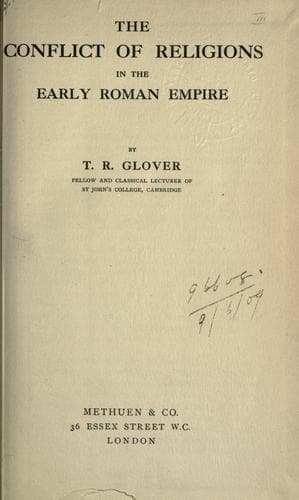
The Conflict of Religions in the Early Roman EmpireGlover, T. R. (Terrot Reaveley)
Religion
The Conflict of Religions in the Early Roman Empire
Glover, T. R. (Terrot Reaveley)
Christianity and other religions; Church history -- Primitive and early church, ca. 30-600; Rome -- Religion
For a long time before Justin was done with his exposition, Trypho was
silent--the better part, perhaps, in all controversy. At last, writes
Justin, "I finished. Trypho said nothing for a while, and then he
said, 'You see, we came to the controversy unprepared. Still, I own, I
am greatly pleased to have met you, and I think my friends have the
same feeling. For we have found more than we expected,--or anyone
could have expected. If we could do it at more length, we might be
better profited by looking into the passages themselves. But, since
you are on the point of sailing and expect to embark every day now,--be
sure you think of us as friends, if you go.'"[71] So, with kindly
feelings, Trypho went away unconvinced. And there were others, as
clear of mind, who were as little convinced,--Marcion, for instance,
and Celsus. "The more reasonable among Jews and Christians," says
Celsus, "try to allegorize them [the Scriptures], but they are beyond
being {194} allegorized and are nothing but sheer mythology of the
silliest type. The supposed allegories that have been made are more
disgraceful than the myths and more absurd, in their endeavour to
string together what never can in any way be harmonized--it is folly
positively wonderful for its utter want of perception."[72] The modern
reader may not be so ready as Origen was to suggest that Celsus
probably had Philo in mind.[73]
[Sidenote: Results]
It is clear that, in the endeavour to give Christianity a historical
background and a prophetic warrant, the Apologists lost all
perspective.[74] The compelling personality of Jesus receded behind
the vague figure of the Christ of prophecy; and, in their
pre-occupation with what they themselves called "types and shadows,"
men stepped out of the sunlight into the shade and hardly noticed the
change. Yet there is still among the best of them the note of love of
Jesus--"do not speak evil of the crucified," pleads Justin, "nor mock
at his stripes, whereby all may be healed, as _we_ have been
healed."[75] And after all it was an instinct for the truth and
universal significance of Jesus that carried them away. He must be
eternal; and they, like the men of their day, thought much of the
beginning and the end of creation, and perhaps found it easier than we
do,--certainly more natural,--to frame schemes under which the Eternal
Mind might manifest itself. Eschatology, purpose, foreknowledge,
pervade their religious thought, and they speak with a confidence which
the centuries since the Renaissance have made more and more impossible
for us, who find it hard enough to be sure of the fact without
adventuring ourselves in the possibilities that lie around it. None
the less the centre of interest was the same for them as for us--what
_is_ the significance of Jesus of Nazareth? For them the facts of his
life and of his mind had often less value than the fancy that they
fulfilled prophecy; Celsus said outright that the Christians altered
Public-domain text, read in full here on John Shaqi.
Reviews
Reviews
No reviews yet
Be the first to share your thoughts on this work.
Elsewhere in the archive
Join the Discussion
Join the discussion
Sign in to leave a comment or review.
Sign InorCreate an account