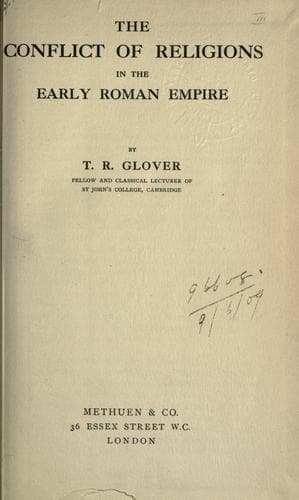
The Conflict of Religions in the Early Roman EmpireGlover, T. R. (Terrot Reaveley)
Religion
The Conflict of Religions in the Early Roman Empire
Glover, T. R. (Terrot Reaveley)
Christianity and other religions; Church history -- Primitive and early church, ca. 30-600; Rome -- Religion
[36] Barnabas, 10; cf. Pliny, _N.H._ 8, 218, on the hare; and Plutarch,
_de Iside et Osiride_, 353 F, 363 F, 376 E, 381 A (weasel), for similar
zoology and symbolism. Clem. Alex. _Str._ ii, 67; v, 51; refers to
this teaching of Barnabas (cf. _ib._ ii, 105).
[37] Barnabas, 9.
[38] _Trypho_, 23.
[39] _Ibid._ 11.
[40] _Jerem._ 31, 31; _Trypho_, 11; Tert. _adv. Jud._ 3.
[41] _Is._ 6, 10; _Trypho_, 12; Cyprian, _Testim._ i, 3.
[42] _Ps._ 82, 5; _Trypho_, 124; Cyprian, _Testim._ i, 3.
[43] _Is._ 42, 19; _Trypho_, 123, where the plural is used.
[44] _Is._ 29, 11; Cyprian, _Testim._ i, 4.
[45] _Trypho_, 133.
[46] _Trypho_, 134.
[47] Cyprian, _Testim._ i, 21; Justin, _Trypho_, 12; Tert. _adv. Marc._
iii, 20.
[48] _Trypho_, 29.
[49] _c. Cels._ ii, 28,
[50] Lactantius, _de mort. persec._ 2.
[51] Tertullian lays down the canon (_adv. Marc._ iii, 5) _pleraque
figurate portenduntur per aenigmata et allegorias et parabolas, aliter
intelligenda quam scripta sunt_; but (_de resurr. carnis_, 20) _non
omnia imagines sed et veritates, nec omnia umbrae sed et corpora, e.g._
the Virgin-birth is not foretold in figure.
[52] _Trypho_, 62, 129; Barnabas, 5, 5; Tert. _adv. Prax._ 12.
[53] _Trypho_, 56.
[54] _Ibid._ 56.
[55] _Ibid._ 56.
[56] _Trypho_, 56, 57.
[57] Trypho, 127. Tert. _adv. Marc._ ii, 27. Quaecunque exigitis
deodigna, habebuntur in patre invisibili incongressibilique et placido
et, ut ita dixerim, philosophorum deo. Quaecunque autem ut indigna
reprehenditis, deputabuntur in filio, etc. Cf. on the distinction
Tert. _adv. Prax._ 14 ff. Cf. the language of Celsus on God
"descending," see p. 248.
[58] _Trypho_, 126. Other titles are quoted by Justin, _Trypho_, 61.
[59] _Trypho_, 128. Cf. Tertullian, _adv. Marc._ ii, 27, _Ille est qui
descendit, ille qui interrogat, ille qui postulat, ille qui jurat; adv.
Prax._ 15, _Filius itaque est qui...._
[60] _Gen._ 49, 8-12; _Trypho_, 52, 53; _Apol._ i, 32; Cyprian,
_Testim._ i, 21.
[61] Tert. _adv. Jud._ 14.
[62] _Trypho_, 40; Tert. _adv. Jud._ 14; Barnabas, 7.
[63] _Trypho_, 66. Isaiah vii and viii.
[64] _Trypho_, 67.
[65] _Trypho_, 71.
[66] _Trypho_, 84. Cf. Tert. _adv. Jud._ 9 = _adv. Marc._ iii, 13.
[67] _Trypho_, 77: Tert. _adv. Jud._ 9 = _adv. Marc._ iii, 13; both
referring to _Psalm_ 71.
[68] _Trypho_, 79.
[69] _Trypho_, 75; _Exodus_ 23, 20.
[70] Barnabas, 9, 8 (the subject of 'saith' may in each case be 'he').
Clement of Alexandria cites this and adds a mystic and mathematical
account of this suggestive figure 318. _Strom._ vi. 84.
[71] _Trypho_, 142.
[72] Celsus _ap._ Orig. _c. Cels._ iv, 50, 51.
[73] Especially when he finds Celsus referring to the dialogue of Jason
and Papiscus as "more worthy of pity and hatred than of laughter"; _c.
Cels._ iv, 52.
Public-domain text, read in full here on John Shaqi.
Reviews
Reviews
No reviews yet
Be the first to share your thoughts on this work.
Elsewhere in the archive
Join the Discussion
Join the discussion
Sign in to leave a comment or review.
Sign InorCreate an account