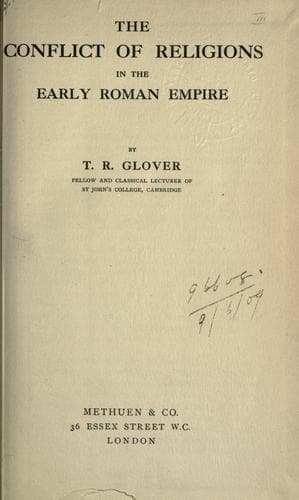
The Conflict of Religions in the Early Roman EmpireGlover, T. R. (Terrot Reaveley)
Religion
The Conflict of Religions in the Early Roman Empire
Glover, T. R. (Terrot Reaveley)
Christianity and other religions; Church history -- Primitive and early church, ca. 30-600; Rome -- Religion
[74] Porphyry (cited by Euseb. _E.H._ vi, 19), says they made riddles
of what was perfectly plain in Moses, their expositions would not hang
together, and they cheated their own critical faculty, _to kritikon tes
psyches katagoeteusantes_.
[75] _Trypho_, 137.
{196}
CHAPTER VII
"GODS OR ATOMS?"
In the first two centuries of our era a great change came over the
ancient world. A despised and traditional religion, under the stimulus
of new cults coming from the East, revived and re-asserted its power
over the minds of men. Philosophy, grown practical in its old age,
forsook its youthful enthusiasm for the quest of truth, and turned
aside to the regulation of conduct, by means of maxims now instead of
inspiration, and finally, as we have seen, to apology for the ancient
faith of the fathers. Its business now was to reconcile its own
monotheistic dogma with popular polytheistic practice. It was perhaps
this very reconciliation that threw open the door for the glowing
monotheism of the disciples of Jesus; but, whatever the cause,
Christianity quickly spread over the whole Roman Empire. We are apt to
wonder to-day at the great political and national developments that
have altered the whole aspect of Europe since the French Revolution,
and to reflect rather idly on their rapidity. Yet the past has its own
stories of rapid change, and not the least striking of them is the
disappearance of that world of thought which we call Classical. By 180
A.D. nearly every distinctive mark of classical antiquity is gone--the
old political ideas, the old philosophies, the old literatures, and
much else with them. Old forms and names remain--there are still
consuls and archons, poets and philosophers, but the atmosphere is
another, and the names have a new meaning, if they have any at all.
But the mere survival of the names hid for many the fact that they were
living in a new era.
[Sidenote: Marcus Aurelius]
In the reign of Marcus Aurelius, however, the signs of change became
more evident, and men grew conscious that some transformation of the
world was in progress. A great plague, the scanty records of which
only allow us to speak in {197} vague terms of an immense reduction in
population[1]--barbarism active upon the frontier of an Empire not so
well able as it had fancied to defend itself--superstitions, Egyptian
and Jewish, diverting men from the ordinary ways of civic duty--such
were some of the symptoms that men marked. Under the weight of
absurdity, quietism and individualism, the state seemed to be sinking,
and all that freedom of mind which was the distinctive boast of
Hellenism was rapidly being lost.
Public-domain text, read in full here on John Shaqi.
Reviews
Reviews
No reviews yet
Be the first to share your thoughts on this work.
Elsewhere in the archive
Join the Discussion
Join the discussion
Sign in to leave a comment or review.
Sign InorCreate an account