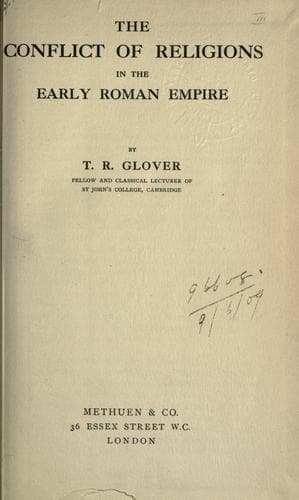
The Conflict of Religions in the Early Roman EmpireGlover, T. R. (Terrot Reaveley)
Religion
The Conflict of Religions in the Early Roman Empire
Glover, T. R. (Terrot Reaveley)
Christianity and other religions; Church history -- Primitive and early church, ca. 30-600; Rome -- Religion
Dialogue in former days had been the vehicle of speculation--"had
trodden those aerial plains on high above the clouds, where the great
Zeus in heaven is borne along on winged car." But it was to do so no
more, and in an amusing piece Lucian represents Dialogue personified as
bringing a suit against him for outrage. Had Lucian debased Dialogue,
by reducing him to the common level of humanity and making him
associate with such persons as Aristophanes and Menippus, one a
light-hearted mocker at things sacred, the other a barking, snarling
dog of a Cynic,--thus turning Dialogue into a literary Centaur, neither
fit to walk nor able to soar? Or was Dialogue really a musty, fusty,
superannuated creature, and greatly improved now for having a bath and
being taught to smile and to go genially in the company of Comedy?
Between the attack and the defence, the case is fairly stated.[16]
Lucian created a new {203} mode in writing--or perhaps he revived it,
for it is not very clear how much he owes to his favourite Menippus,
the Gadarene Cynic and satirist of four centuries before.
Menippus however has perished and Lucian remains and is read; for,
whatever else is to be said of him, he is readable. He has not lost
all the traces of the years during which he consorted with Rhetoric; at
times he amplifies and exaggerates, and will strain for more point and
piquancy than a taste more sure would approve. Yet he has the instinct
to avoid travesty, and his style is in general natural and simple,
despite occasional literary reminiscences. His characters talk,--as
men may talk of their affairs, when they are not conscious of being
overheard,--with a naive frankness not always very wise, with a freedom
and common sense, and sometimes with a folly, that together reveal the
speaker. They rarely declaim, and they certainly never reach any high
level of thought or feeling. The talk is slight and easy--it flickers
about from one idea to another, and gives a strong impression of being
real. If it is gods who are talking, they become surprisingly
human--and even _bourgeois_, they are so very much at home among
themselves. Lucian's skill is amazing. He will take some episode from
Homer and change no single detail, and yet, as we listen to the
off-hand talk of the gods as they recount the occurrence, we are
startled at the effect--the irony is everywhere and nowhere; the
surprises are irresistible. Zeus, for instance, turns out to have more
literary interests than we suppose; he will quote Homer and make a
Demosthenic oration to the gods, though alas! his memory fails him in
the middle of a sentence;[17] he laments that his altars are as cold as
Plato's _Laws_ or the syllogisms of Chrysippus. He is the frankest
gentleman of heaven, and so infinitely obliging!
Public-domain text, read in full here on John Shaqi.
Reviews
Reviews
No reviews yet
Be the first to share your thoughts on this work.
Elsewhere in the archive
Join the Discussion
Join the discussion
Sign in to leave a comment or review.
Sign InorCreate an account