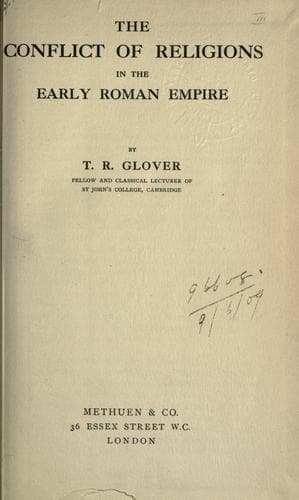
The Conflict of Religions in the Early Roman Empire — John Shaqi
The Conflict of Religions in the Early Roman EmpireGlover, T. R. (Terrot Reaveley)
Religion
The Conflict of Religions in the Early Roman Empire
Glover, T. R. (Terrot Reaveley)
Christianity and other religions; Church history -- Primitive and early church, ca. 30-600; Rome -- Religion
I. ROMAN RELIGION . . . . . . . . . . . . . 1
II. THE STOICS . . . . . . . . . . . . . . . 33
III. PLUTARCH . . . . . . . . . . . . . . . . 75
IV. JESUS OF NAZARETH . . . . . . . . . . . . 113
V. THE FOLLOWERS OF JESUS . . . . . . . . . 141
VI. THE CONFLICT OF CHRISTIAN AND JEW . . . . 167
VII. "GODS OR ATOMS?" . . . . . . . . . . . . 196
VIII. CELSUS . . . . . . . . . . . . . . . . . 239
IX. CLEMENT OF ALEXANDRIA . . . . . . . . . . 262
X. TERTULLIAN . . . . . . . . . . . . . . . 305
INDEX . . . . . . . . . . . . . . . . . . 349
{1}
THE CONFLICT OF RELIGIONS
IN THE EARLY ROMAN EMPIRE
CHAPTER I
ROMAN RELIGION
On the Ides of March in the year 44 B.C. Julius Caesar lay dead at the
foot of Pompey's statue. His body had twenty three wounds. So far the
conspirators had done their work thoroughly, and no farther. They had
made no preparation for the government of the Roman world. They had
not realized that they were removing the great organizing intelligence
which stood between the world and chaos, and back into chaos the world
swiftly rolled. They had hated personal government; they were to learn
that the only alternative was no government at all. "Be your own
Senate yourself"[1] wrote Cicero to Plancus in despair. There was war,
there were faction fights, massacres, confiscations, conscriptions.
The enemies of Rome came over her borders, and brigandage flourished
within them.
At the end of his first _Georgic_ Virgil prays for the triumph of the
one hope which the world saw--for the preservation and the rule of the
young Caesar, and he sums up in a few lines the horror from which
mankind seeks to be delivered. "Right and wrong are confounded; so
many wars the world over, so many forms of wrong; no worthy honour is
left to the plough; the husbandmen are marched away and the fields grow
dirty; the hook has its curve straightened into the sword-blade. In
the East, Euphrates is stirring up war, in the West, Germany: nay,
close-neighbouring cities break their mutual league and draw the sword,
and the war-god's unnatural fury rages over the whole world; even as
when in the Circus the chariots burst {2} from their floodgates, they
dash into the course, and pulling desperately at the reins the driver
lets the horses drive him, and the car is deaf to the curb."[2]
Virgil's hope that Octavian might be spared to give peace to the world
was realized. The foreign enemies were driven over their frontiers and
thoroughly cowed; brigandage was crushed, and finally, with the fall of
Antony and Cleopatra, the government of the whole world was once more,
after thirteen years of suffering, disorder and death, safely gathered
into the hands of one man. There was peace at last and Rome had
leisure to think out the experience through which she had passed.
Public-domain text, read in full here on John Shaqi.
Reviews
Reviews
No reviews yet
Be the first to share your thoughts on this work.
Join the Discussion
Join the discussion
Sign in to leave a comment or review.
Sign InorCreate an account