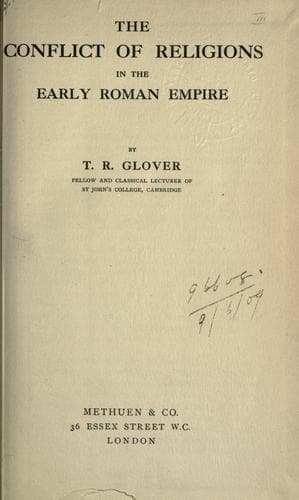
The Conflict of Religions in the Early Roman EmpireGlover, T. R. (Terrot Reaveley)
Religion
The Conflict of Religions in the Early Roman Empire
Glover, T. R. (Terrot Reaveley)
Christianity and other religions; Church history -- Primitive and early church, ca. 30-600; Rome -- Religion
The thirteen years between the murder of Caesar and the battle of Actium
were only a part of that experience; for a century there had been
continuous disintegration in the State. The empire had been increased,
but the imperial people had declined. There had been civil war in Rome
over and over again--murder employed as a common resource of politics,
reckless disregard of the sacredness of life and property, and thorough
carelessness of the State. The impression that England made upon
Wordsworth in 1802 was precisely that left upon the mind of the serious
Roman when he reflected upon his country. All was "rapine, avarice,
expense."
Plain living and high thinking are no more:
The homely beauty of the good old cause
Is gone; our peace, our fearful innocence,
And pure religion breathing household laws.
Such complaints, real or conventional, are familiar to the readers of
the literature of the last century before Christ. Everyone felt that a
profound change had come over Rome. Attempts had been made in various
ways to remedy this change; laws had been passed; citizens had been
banished and murdered; armies had been called in to restore ancient
principles; and all had resulted in failure. Finally a gleam of
restoration was seen when Julius began to set things in order, when he
"corrected the year by the Sun" and gave promise of as true and
deep-going a correction of everything else. His murder put an end to
all this at the time, and it took thirteen years to regain the lost
opportunity--and the years were not {3} altogether loss for they proved
conclusively that there was now no alternative to the rule of the
"Prince."
[Sidenote: The cause of Rome's decline]
Accordingly the Prince set himself to discover what was to be done to
heal the hurt of his people, and to heal it thoroughly. What was the
real disease? was the question that men asked; where was the root of
all the evil? why was it that in old days men were honest, governed
themselves firmly, knew how to obey, and served the State? A famous
line of Ennius, written two centuries before, said that the Roman
Commonwealth stood on ancient character, and on men.--
_Moribus antiquis stat res Romano, virisque._
Both these bases of the national life seemed to be lost--were they
beyond recall? could they be restored? What was it that had made the
"ancient character"? What was the ultimate difference between the old
Roman and the Roman of the days of Antony and Octavian? Ovid
congratulated himself on the perfect congruity of the age and his
personal character--
_haec aetas moribus apta meis--_
and he was quite right. And precisely in the measure that Ovid was
right in finding the age and his character in agreement, the age and
national character were demonstrably degenerate. It was the great
question before the nation, its statesmen, patriots and poets, to find
why two hundred years had wrought such a change.
Public-domain text, read in full here on John Shaqi.
Reviews
Reviews
No reviews yet
Be the first to share your thoughts on this work.
Join the Discussion
Join the discussion
Sign in to leave a comment or review.
Sign InorCreate an account