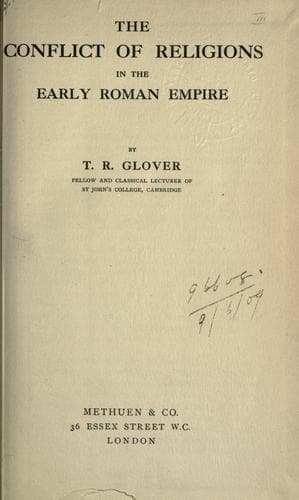
The Conflict of Religions in the Early Roman EmpireGlover, T. R. (Terrot Reaveley)
Religion
The Conflict of Religions in the Early Roman Empire
Glover, T. R. (Terrot Reaveley)
Christianity and other religions; Church history -- Primitive and early church, ca. 30-600; Rome -- Religion
Religion, similarly, "often and often has given birth to sinful and
unholy deeds." The illustration, which he uses, is the sacrifice of
Iphigenia, and it seems a little remote. Yet Pliny says that in 97
B.C. in the consulship of Lentulus and Crassus, a decree of the Senate
forbade human sacrifice--_ne homo immolaretur_. "It cannot be
estimated," he goes on, "what a debt is owed to the Romans who have
done away (in Gaul and Britain) with monstrous rites, in which it was
counted the height of religion to kill a man, and a most healthful
thing to eat him."[92] Elsewhere he hints darkly at his own age having
seen something of the kind, and there is an obscure allusion in
Plutarch's life of Marcellus to "unspeakable rites, that none may see,
which are performed (?) upon Greeks and Gauls."[93] "At the temple of
Aricia," says Strabo, "there is a barbarian and Scythian practice. For
there is there established a priest, a runaway slave, who has killed
with his own hand his predecessor. There he is, then, ever sword in
hand, peering round about, lest he should be attacked, ready to defend
himself." Strabo's description of the temple on the lake and the
precipice overhanging it adds to the impressiveness of the scene he
thus pictures.[94] If human sacrifice was rare in practice, none the
less it was in the minds of men.
_Tantum religio potuit suadere malorum_
concludes Lucretius, and yet it was not perhaps his last thought.
M. Patin has a fine study of the poet in which he deals with "the
anti-Lucretius in Lucretius." Even in the matter of religion, his keen
observation of Nature frequently suggests difficulties which are more
powerfully expressed and more convincing than the arguments with which
he himself tries to refute them. "When we look up to the heavenly
regions of the great universe, the aether set on high above the
glittering stars, and the {27} thought comes into our mind of the sun
and moon and their courses; then indeed in hearts laden with other woes
that doubt too begins to wake and raise its head--can it be perchance,
after all, that we have to do with some vast Divine power that wheels
those bright stars each in his orbit? Again who is there whose mind
does not shrink into itself with fear of the gods, whose limbs do not
creep with terror, when the parched earth rocks under horrible blow of
the thunderbolt, and the roar sweeps over the vast sky? ... When too
the utmost fury of the wild wind scours the sea and sweeps over its
waters the admiral with his stout legions and his elephants, does he
not in prayer seek peace with the gods? ... but all in vain, since,
full oft, caught in the whirlwind, he is driven, for all his prayers,
on, on to the shoals of death. Thus does some hidden power trample on
mankind.... Again, when the whole earth rocks under their feet, and
towns fall at the shock or hang ready to collapse, what wonder if men
despise themselves, and make over to the gods high prerogative and
Public-domain text, read in full here on John Shaqi.
Reviews
Reviews
No reviews yet
Be the first to share your thoughts on this work.
Join the Discussion
Join the discussion
Sign in to leave a comment or review.
Sign InorCreate an account