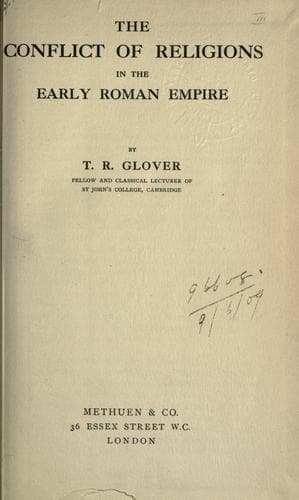
The Conflict of Religions in the Early Roman EmpireGlover, T. R. (Terrot Reaveley)
Religion
The Conflict of Religions in the Early Roman Empire
Glover, T. R. (Terrot Reaveley)
Christianity and other religions; Church history -- Primitive and early church, ca. 30-600; Rome -- Religion
marvellous powers to govern all things?"[95]
That Lucretius should be so open to impressions of this kind, in spite
of his philosophy, is ra measure of his greatness as a poet. It adds
weight and worth to all that he says--to his hatred of the polytheism
and superstition round about him, and to his judgment upon their effect
in darkening and benumbing the minds of men. He understands the
feelings which he dislikes--he has felt them. The spectacle of the
unguessed power that tramples on mankind has moved him; and he has
suffered the distress of all delicate spirits in times of bloodshed and
disorder. He knows the effect of such times upon those who still
worship. "Much more keenly in evil days do they turn their minds to
religion."[96]
{28}
We have now to consider another poet, a disciple of Lucretius in his
early years, who, under the influence of Nature and human experience,
moved away from Epicureanism, and sought reconciliation with the gods,
though he was too honest with himself to find peace in the systems and
ideas that were yet available.
[Sidenote: Virgil]
Virgil was born in the year 70 B.C.--the son of a little self-made man
in a village North of the Po. He grew up in the country, with a spirit
that year by year grew more sensitive to every aspect of the world
around him. No Roman poet had a more gentle and sympathetic love of
Nature; none ever entered so deeply and so tenderly into the sorrows of
men. He lived through forty years of Civil War, veiled and open. He
saw its effects in broken homes and aching hearts, in coarsened minds
and reckless lives. He was driven from his own farm, and had, like
AEneas, to rescue an aged and blind father. Under such experience his
early Epicureanism dissolved--it had always been too genial to be the
true kind. The Epicurean should never go beyond friendship, and Virgil
loved. His love of the land in which he was born showed it to him more
worthy to be loved than men had yet realized. Virgil was the pioneer
who discovered the beauty, the charm and the romance of Italy. He
loved the Italians and saw poetry in their hardy lives and quiet
virtues, though they were not Greeks. His love of his father and of
his land opened to him the significance of all love, and the deepening
and widening of his experience is to be read in the music, stronger and
profounder, that time reveals in his poetry.
Public-domain text, read in full here on John Shaqi.
Reviews
Reviews
No reviews yet
Be the first to share your thoughts on this work.
Join the Discussion
Join the discussion
Sign in to leave a comment or review.
Sign InorCreate an account