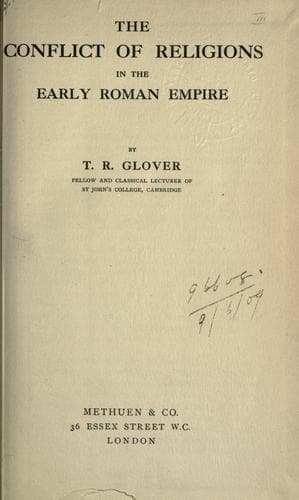
The Conflict of Religions in the Early Roman EmpireGlover, T. R. (Terrot Reaveley)
Religion
The Conflict of Religions in the Early Roman Empire
Glover, T. R. (Terrot Reaveley)
Christianity and other religions; Church history -- Primitive and early church, ca. 30-600; Rome -- Religion
Celsus held that Christians spoke of God in a way that was neither holy
nor guiltless (_ouch hosios oud' euagos_, iv, 10); and he hinted that
they did it to astonish ignorant listeners.[21] For himself, he was
impressed with the thought, which Plato has in the _Timaeus_,--a
sentence that sums up what many of the most serious and religious
natures have felt and will always feel to be profoundly true: "The
maker and father of this {245} whole fabric it is hard to find, and,
when one has found him, it is impossible to speak of him to all
men."[22] Like the men of his day, a true and deep instinct led him to
point back to "inspired poets, wise men and philosophers," and to Plato
"a more living (_energesteron_) teacher of theology"[23]--"though I
should be surprised if you are able to follow him, seeing that you are
utterly bound up in the flesh and see nothing clearly."[24] What the
sages tell him of God, he proceeds to set forth.
"Being and becoming, one is intelligible, the other visible, (_noeton,
horaton_). Being is the sphere of truth; becoming, of error. Truth is
the subject of knowledge; the other of opinion. Thought deals with the
intelligible; sight with the visible. The mind recognizes the
intelligible, the eye the visible.
"What then the Sun is among things visible,--neither eye, nor
sight--yet to the eye the cause of its seeing, to sight the cause of
its existing (_synistathai_) by his means, to things visible the cause
of their being seen, to all things endowed with sensation the cause of
their existence (_ginesthai_) and indeed the cause himself of himself
being seen; this HE is among things intelligible (_noeta_), who is
neither mind, nor thought, nor knowledge, but to the mind the cause of
thinking, to thought of its being by his means, to knowledge of our
knowing by his means, to all things intelligible, to truth itself, and
to being itself, the cause that they are--out beyond all things
(_panton epekeina on_), intelligible only by some unspeakable faculty.
"So have spoken men of mind; and if _you_ can understand anything of
it, it is well for you. If you suppose a spirit descends from God to
proclaim divine matters, it would be the spirit that proclaims this,
that spirit with which men of old were filled and in consequence
announced much that was good. But if you can take in nothing of it, be
silent and hide your own ignorance, and do not say that those who see
are blind, and those who run are lame, especially when you yourselves
are utterly crippled and mutilated in soul, and live in the body--that
is to say, in the dead element."[25]
Public-domain text, read in full here on John Shaqi.
Reviews
Reviews
No reviews yet
Be the first to share your thoughts on this work.
Elsewhere in the archive
Join the Discussion
Join the discussion
Sign in to leave a comment or review.
Sign InorCreate an account