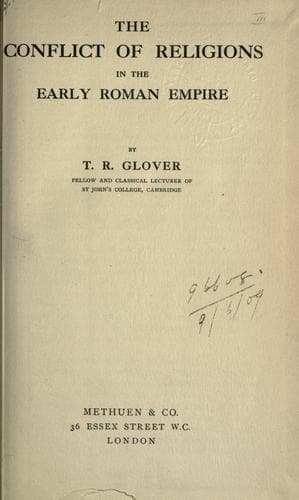
The Conflict of Religions in the Early Roman EmpireGlover, T. R. (Terrot Reaveley)
Religion
The Conflict of Religions in the Early Roman Empire
Glover, T. R. (Terrot Reaveley)
Christianity and other religions; Church history -- Primitive and early church, ca. 30-600; Rome -- Religion
Origen says that Celsus is constantly guilty of tautology, and the
reiteration of this charge of ignorance and want of {246} culture is at
least frequent enough. Yet if the Christian movement had been confined
to people as vulgar and illiterate as he suggests, he might not have
thought it worth his while to attack the new religion. His hint of the
propagation of the Gospel by slaves in great houses, taken with the
names of men of learning and position, whom we know to have been
converted, shows the seriousness of the case. But to avoid the further
charge which Origen brings against Celsus of "mixing everything up," it
will be better to pursue Celsus' thoughts of God.
"I say nothing new, but what seemed true of old (_palai dedogmena_).
God is good, and beautiful, and happy, and is in that which is most
beautiful and best. If then he 'descends to men,' it involves change
for him, and change from good to bad, from beautiful to ugly, from
happiness to unhappiness, from what is best to what is worst. Who
would choose such a change? For mortality it is only nature to alter
and be changed; but for the immortal to abide the same forever. God
would not accept such a change."[26] He presents a dilemma to the
Christians; "Either God really changes, as they say, to a mortal
body,--and it has been shown that this is impossible; or he himself
does not change, but he makes those who see suppose so, and thus
deceives and cheats them. Deceit and lying are evil, taken generally,
though in the single case of medicine one might use them in healing
friends who are sick or mad--or against enemies in trying to escape
danger. But none who is sick or mad is a friend of God's; nor is God
afraid of any one, so that he should use deceit to escape danger."[27]
God in fact "made nothing mortal; but God's works are such things as
are immortal, and _they_ have made the mortal. The soul is God's work,
but the nature of the body is different, and in this respect there is
no difference between the bodies of bat, worm, frog, and man. The
matter is the same and the corruptible part is alike."[28]
[Sidenote: God's anger]
Public-domain text, read in full here on John Shaqi.
Reviews
Reviews
No reviews yet
Be the first to share your thoughts on this work.
Elsewhere in the archive
Join the Discussion
Join the discussion
Sign in to leave a comment or review.
Sign InorCreate an account